If you are not living in Antarctica, you must have heard the famous verse from the holy Gita, which goes like this:
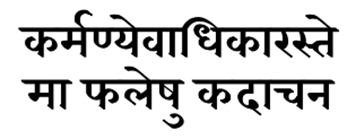
Which literally means that “You have the right to perform your actions (कर्म/karma), but you are not entitled to the fruits (फल/fal) of your actions”.
On the face of it, it seems very motivational in the sense that it encourages a person to be focussed towards one’s own “karma” (Actions), which only is in one’s own control. And be free from the desire of the “fal” (fruits/rewards) that the Karma may bring to a person, which more often than not, is not in one’s control. Whenever, a person is in doubt that whether or not one should act or not, then this verse can help solve the dilemma. For example, the great Arjuna when faced with the moral dilemma that whether he should fight against his own brothers in the battle of Mahabharata, he is reminded by Lord Krishna of his duty (karma) to act as per his “Dharma” and let the results take care of themselves. Take another example of modern times, a soldier goes on to fight battles considering it as his duty, irrespective of the outcome of the war (whether there is a win or there is death).
But as easy and simple as it seems to follow this dictum, it is way too much difficult to follow in practical life. And the reason behind it? Because it is difficult or sometimes even impossible to dissociate oneself from the desire of “fal” while performing “karma”. Infact, the expectation of a “desired result” is the motivation to keep performing your actions. Many of the theories of the subject of public administration specially are centred around this concept.
According to the “goal achievement theory”, if there is expectation of achieving a desired goal, then a person makes small efforts to achieve it, and when his/her efforts are in the direction of that goal, it gives motivation to the person to continue performing the actions. As soon as the link between the expectation of achieving a goal and the goal is severed, the person gets demotivated to perform any action (Karma). For example, if you expect that working hard (karma) will earn you an Olympic medal (goal), then you will be motivated to make more efforts. But, if you are told to work hard even if you don’t expect that you can actually win an Olympic medal will be living in a fool’s errand! As soon as you know that however hard you work, you can never win an Olympic medal, then the link between your Karma and Fal breaks, and you are not motivated to make harder efforts. Even in the professional life, if you know that making more efforts can result into faster promotions and performance bonus, then you will be motivated to work harder, otherwise not.
The important thing to notice in all this process of performing Karma, is that there is always the thought of achieving certain goals (Fal) in the mind. It is next to impossible to dissociate oneself from the expectation of positive result while performing, otherwise the whole purpose of performing goes for a toss. For example, even before the start of World Cup and even before a match is played, we expect our team to win. Here, my friend, lies the “karma” conundrum!!!! As Shakespeare said in renowned play Hamlet “To be or not to be, that is the question”! करें तो करें क्या?
If Lord Krishna is to be believed, then do your Karma. Period.
If modern public administration theories and practicality is to be believed, then do your Karma contingent upon the expectation of achieving the result. Period.
Or even better, don’t do any Karma and just expect good result like a “Sheikh chilli” 🙂
And here Gen Z will say- I don’t know what you are talkin’ about. I only know one thing about Karma that “Karma is a bitch” And I don’t know why? 😀
Till next time….
 Anupam- The Dreamer
Leave a comment