The history behind Official Development Assistance (ODA)
Very recently, after the rebirth of Trump’s second presidency, the US government is gung-ho about the withdrawal of development assistance provided through USAID (US Agency for International Development) to various developing and under-developed countries. And it has been branded as they were doing charity at the expense of their taxpayer’s money! But, the reality that it hides is more than what is being portrayed. If you are interested in developmental politics, then this article is for you. Otherwise, you may just skip over and enjoy your weekend. Let’s go…..
After the World War II, there was a growing concern in the UN about providing development assistance to the third world nations to help them develop, in terms of providing better education, healthcare, infrastructure and investments. This was done basically to help the poor nations overcome the poverty trap. Trap because they didn’t have the money for investments to grow their economy, which in turn reduced their capacity for economic development and subsequent investments therefrom. But, the problem was that most of the assistance was coming in the form of loans, export credits, associated finance etc. So, it was a burden on the poor nations, who took loans from the developed nations to repay them back, which kept them in perpetual debt trap.
To overcome this constraint of poor nations, there was a landmark report from a commisoon headed by former Canadian Prime Minister, Lester Pearson, which in 1969 advocated the following w.r.t. increasing the development assistance from the rich nations:
“…seek agreement on a target for official aid which is simple, attainable, and adequate, without, however, limiting other forms of aid within the 1 per cent target figure. We therefore recommend that each aid-giver increase commitments of official development assistance to the level necessary for net disbursements to reach 0.70 per cent of its gross national product by 1975 or shortly thereafter, but in no case later than 1980.”
So, it was recommended that the developed nations, give atleast 1% of their GDP as official assistance (called Official Development Assistance (ODA)), out of which government to government assistance should account for 0.7% of their GDP, with balance coming from the corporate sector, charitable organizations etc. As a consequence, the ODA chart looked like the following in 2012:
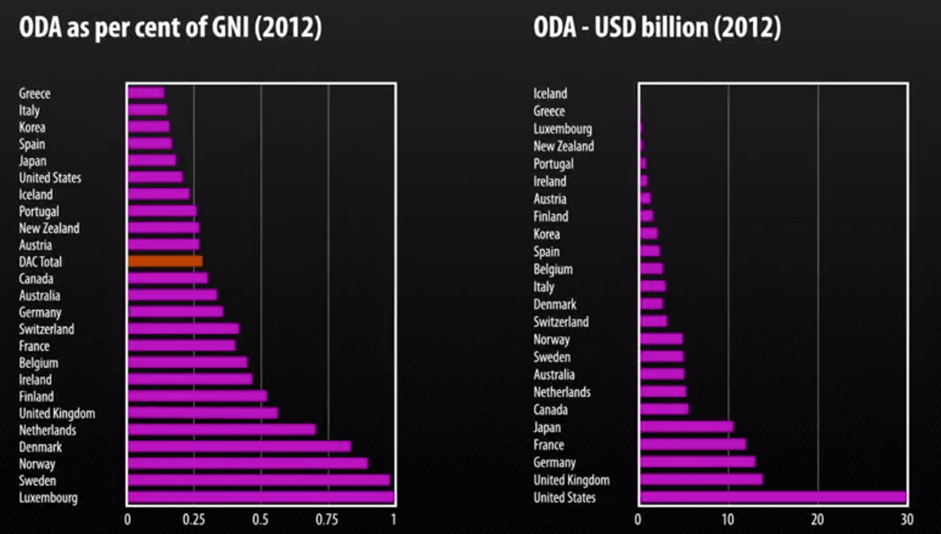
Source: OECD data
As we can see from the above, the countries with more than 0.7% contribution as a percentage of their GDP are the Netherlands, Denmark, Norway, Sweden and Luxembourg. And where is the USA? Less than 0.25%! Although, it is the largest donor in terms of absolute numbers, yet this is nowhere near the levels recommended by Pearson Commission.
Even if the USAID is withdrawing their contribution, the other countries are not, which is a testament to their commitment to the poor nations! And this is not a charity by the developed world to the Least Developed Countries (LDCs), rather it is a development assistance to help create a poverty-free world by making the poor countries break from the poverty trap. And this cannot be seen as charity, as there was so much wealth drain from these poor nations during the period of colonization to the developed world, so in a way it is their own money which is coming back in some form. So, it is just a little redistribution of wealth from the rich part of the world to the poor parts.
The International Labour Organization’s 1944 Declaration of Philadelphia was “Poverty anywhere is a threat to prosperity everywhere”. So, ending of extreme poverty by 2030, a goal set by the United Nations, is not just desirable but also essential for human development. The earlier we understand that, better it will be for every rich and poor nation on this planet. The efforts and assistance have to come from governments of rich countries, the philanthropic organizations, the corporate social responsibility contributions, international aid agencies, NGOs etc. This way, we can make this world a little better place than it is now….and what better thing than to achieve the goal of extreme poverty elimination by 2030!
 Anupam- The Dreamer
Leave a comment