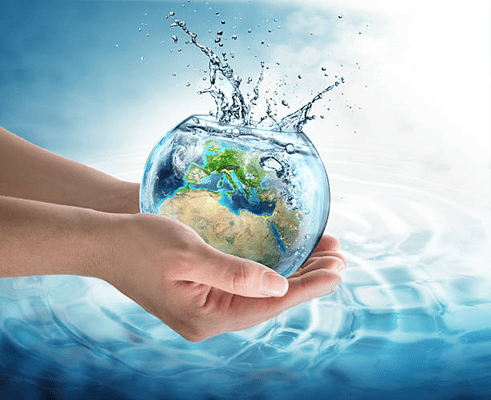
Of all the issues that I hold dear to my heart on the subject of sustainability, water availability, conservation and its proper usage is a special one. On the face of it, it may seem a very trivial issue to many, but somehow it is not as trivial as it seems and no one should take it at the face value. Infact, we would be fools of the highest order, if we continue to think that “Why should we bother, because water is a free resource?”. I will prove that it is not, and it is the single most important thing that will decide whether the humanity will survive on this planet for long or not. So, let’s begin the sojourn….
The humans physiologically need only few essential things to survive- clean air to breathe, clean water to drink, and food to eat. Of these three, food availability also depends upon water, as no crops/fruit trees can grow without water. So, essentially it all boils down to two- one is air, and the other is water. Clean air (devoid of excessive carbon dioxide and global warming) is a sine qua non and it is subject matter to be dealt some other time. Clean water, is what we are here for today.
Historically, all the ancient civilizations prospered near the major rivers of the world. Be it Harappan civilization on the banks of river Indus, Mesopotamian civilization near the banks of river Tigris-Euprates, Chinese civilization near Yellow river and Egyptian civilization near the river Nile. As discussed above, these rivers offered clean drinking potable water to all the humans, which was essential for their basic needs of food and water. No civilization has survived, much less became great, without the availability of water. Even closer to home, we see that many great kingdoms in ancient and medieval India are concentrated on the banks of one river or the other, take for example, Magadha in the north, Cholas in the South, or even Mughals and Marathas in the medieval period. Without water, there is no food production. And without food, there is no army to wage wars. It is as simple as that!
But as the human population soared, the equation between the water availability and the number of humans reversed. Earlier, before the industrial revolution, the human population in the world was around 800 million and there was no water scarcity, whatsoever. One person could literally bathe in like a buffalo in a pond! But after that, as the world population has soared to about 8000 million now, the per capital water availability has drastically come down. We are in the situation where about 2000 million (2 billion) people in the world, that is staggering one-fourth of humanity lacking access to safe drinking water! We may have achieved several feats in terms of science and technology, but we have faltered big when it comes to ensuring the 2 essential needs that a human needs to survive- one of them being water!
I read an amazing quote sometime ago, which says:
“Water is the dividing line between poverty and prosperity.”
This is not just a quote, but a reality! I will prove it how. Several villages in India were in the grasp of abject poverty because they did not have enough water to meet their basic needs. With the vision of great leaders like Anna Hazare, Popatrao Pawar, the villages Ralegan Siddhi and Hiwre Bazar started rainwater harvesting and tree plantation. When water availability raised, the trees and crops production increased, there was enough food to eat and water to drink for the people as well for the animals, especially the domestic ones like cows, buffalos, goats, chicken etc. As people have surplus grains or animal products like dairy, they start to trade and make money. When there is money, then the other facilities like good schools, hospitals, cable connections etc. follow. It’s all interlinked, you see.
And picture a scenario, when there is no water, only “banjar” land. What option do the people have, then? Distress Migration to some other place is the only option, where they can find water. You can observe that the places with low water availability, like deserts and mountains are sparsely populated, because life there is tough for people to survive. Take for example, Sub-Saharan Africa, it is one of the most poor regions of the world. Apart from other historical factors like colonization, water availability is the biggest hindrance in development of that region. And don’t think that I am painting a dreadful scenario here. Its not a future scenario anymore. There are news of water crisis face by some cities already. In 2018, the city of Cape Down faced “Day zero”, meaning the taps ran dry! In Bangalore last year, some societies were left with no water, forcing the residents to migrate out in distress. You Google the news, you will find several similar stories. This year in 2025, the Bangalore local authorities have banned the use of potable water for non-essential activities like gardening, car washing, swimming pools etc. I am sure some billionaire people would go crazy with the idea of no swimming pools and would be more than willing to grease some pockets to fill their private swimming pool in their mansions.
Going forward, with the human population continue to rise, water usage increasing in order to boost food production and industrial output, coupled with growing water need due to lavish lifestyles, the per capital water availability will continue to decline drastically. And mind it, of all the water available on the earth, only about 3% is freshwater fit for drinking. And a large part of that too is locked in glaciers and ice, so a small fraction is actually available for our use. With global warming, the glaciers are receding fast across the world, including in the Upper Himalayas. So, the water availability will be a big issue going forward.
And now the best part, we have become master polluters of limited water that is available to us. The stories of pollution in rivers like Yamuna, Ganga, and others has now become the political hot potato. We are living as if we can pollute the rivers, ponds, lakes as per our wish. The painful sight of water bottles, plastics, human waste, black water, in the water bodies should be a wakeup call. But, we don’t seem to care much. We continue to throw garbage in the water bodies around us, make illegal construction near the river banks, industries continue to release wastewater and effluents with impunity and the agricultural fertilizer waste contributing to eutrophication. We think that why should we bother, “हमारे घर में तो नल से साफ़ पानी आता है। जिस दिन नहीं आएगा उस दिन सोचेंगे।“
I indeed have faced a few such scenarios in my life. One was when there was a huge water crisis in Delhi in February 2016 triggered by a community protest in Haryana which blocked a canal. People didn’t bathe for 3 days in the city. And the other one was interesting, when I was in IIT Guwahati. Although we lived close to Brahmaputra river, but one fine day there was some issue in the motor system, due to which the tanks on the hostel top were not filled. And when we woke up, the taps were completely dry. Some of my friends didn’t know this, and went straight to the latrines. And when they were finished they faced catch 22 situation, because there was no water! You can imagine what happened after that! It was indeed a delightful sight. Some were running around different washrooms across the 4 floors, only to find no water. Some were stealing drinking water from their friends who were still sleeping, to wash themselves. There was an utter chaos that day. 😀
This will be the everyday scenario in a few decades at many places, if we don’t wake up today and conserve this precious resource and reduce our water footprint in whatever way we can. Our small steps like reducing water usage in everyday activities, not overusing it while bathing, not polluting water bodies, and reusing wastewater in other activities, wherever possible, rainwater harvesting etc. can go a long way in ensuring continued availability of safe drinking water.
Yesterday was WORLD WATER DAY i.e. 22nd March. On this day, what if some of us take a resolve to reduce our water footprint by even a small amount? What if all of us can take that resolve? What iff….
I will leave you with a doha that Abdul Rahim Khan-e-Khana wrote way back in 17th century about the importance of water, even when the water was in bounty:
रहिमन पानी राखिये, बिन पानी सब सून।
पानी गये न ऊबरे, मोती, मानुष, चून॥
 Anupam- The Dreamer
Leave a comment