We have often heard from the people who have done hard work all their life at the ground level that practical knowledge is everything! All theoretical knowledge according to them is just for getting a college degree, which has no meaning in real life. At the other end of spectrum are the people, although in minority, who claim that the theoretical knowledge is more important than the practical knowledge, as it is the basic foundation over which the practical skills can be applied.
The reality to me actually lies somewhere in between. Let me first illustrate this with an easy example. There is a car mechanic named Robert, who has a cumulative experience of about 20 years. He has repaired different types of cars throughout his life including hatchbacks, sedans, luxury cars, and even some heavy vehicles. But, he has obtained only rudimentary education and does not have a college degree. To some people, Robert is the best in the business and their go-to person in the times of need. And why shouldn’t they think so, when Robert has the ability to fix their car within minutes with his immense practical knowledge and skillset. But there is a big issue. Although Robert knows the practical skills acquired over time through experimentation and experience, but Robert doesn’t know how to improve the engine design or how to design a completely new car! Because, all Robert has done in his life is to do the same low-end job over and over again and his customers are happy because Robert is cost-effective and efficient.
Now, consider this. If Robert had a Mechanical Engineering Bachelors degree or a Diploma in Mechanical Engineering or atleast vocational training course about the Internal Combustion Engines, Machine Design, aerodynamics of a vehicle, performed simulation on different softwares, then Robert could have acquired a robust theoretical knowledge also about his field of work. Then, Robert could actually understand how the car actually works and the science behind it. If Robert had this theoretical knowledge to begin with, then he could have become one of the best mechanics in the world. After that, Robert could have found his place in the epitome of car design, manufacturing and racing- a Formula 1 team, where he could have served as a chief mechanic or a design engineer with some of the best constructors of all time like Ferrari, Mercedes, McLaren etc. Just imagine what a fortune could Robert have made by combining his theoretical knowledge with the practical hands-on knowledge.
Without the theoretical knowledge about the engineering of a car, Robert can at best be a roadside “mistri”/ मिस्त्री, earning way below his actual potential. This is you see, the importance of the combination of both the theoretical and practical knowledge. At the same time, if Robert only has theoretical knowledge and zero practical knowledge, then he would be fit only for the role of an armchair professor, who hasn’t seen the actual world out there. He would be teaching old, rotten and cliché curriculum and the same basic courses which used to be taught 100 years ago. There would be no new contribution from his side, as he has never applied this knowledge in the real world and would never know the limitations and flaws in the theory. Because theory, however extensive and detailed it may seem, can never be complete.
The reason for the above assertion is that the theory has to evolve continuously as the understanding about a phenomenon increases with time. For example, the courses that were taught about 50 years ago in a university have become obsolete with time, apart from the basic principles of the subject. Newer approaches and theories have to be evolved with time, aided by the practical experience in the field, application of multi-disciplinary approach, impact of technology on the evolution of a subject etc etc. Because what is theory without practical? It is nothing more than mere bookish knowledge. The fundamental reason why a discipline and its theory came into existence is to improve life of humans in practicality. And if it can’t serve that purpose in practicality, then what is the use of such knowledge.
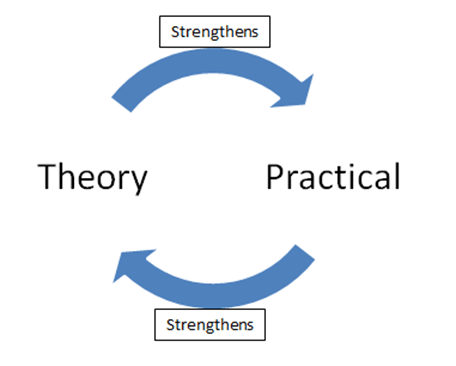
Thus, it is amply clear that theory is as much important, if not more, as the practical knowledge. In summation, theory is the accumulated knowledge of humanity over a number of generations, and it combines the practical experience of thousands of intellectuals who have walked on the face of this Earth before us. So, no matter what, the practical experience of one individual cannot overshadow the practical experiences of thousands of intellectuals. At the same time, there is always a scope for improvement in the theory by an individual, even if it has evolved over time, which can only be obtained by practical experience and experimentation. And this process gives birth to a new theory, which is tried and tested, thereby an individual making a pivotal contribution in the already existing theoretical knowledge base. So, they are not mutually exclusive and cannot survive without each other. Infact, they constitute a cyclical loop, you see, with both of them strengthening each other. Isn’t that a beautiful thing?
And this isn’t just true only for engineering! It is equally applicable in all disciplines of study including medicine, arts, humanities etc. So, what do you like- theory or practical or both?
Till next time….
 Anupam- The Dreamer
Leave a comment