A single day of heavy convectional rainfall in any city today is sufficient to cripple the city life for the next 1-2 days. There would be water loggings here and there, overflowing drains and sewerage system in every locality and heavy traffic jams. In summation, the situation paints a very sorry state of affairs. There is noone in the city who is not impacted by this problem of water logging. It seems that the city is not capable of bearing with just one day rainfall, forget about the rainy seasons. Take for example, the yesterday’s rains accompanied by the storms, which brought Delhi NCR to its knees today. Everywhere, there is a picture of chaos and helplessness. As if we can do nothing to solve this misery once and for all!
We all know the reasons for heavy waterlogging during the rains, those aren’t hidden from anyone. The academic answer to this would be- improper drainage system, encroachment of river banks, illegal encroachment of ponds and other water bodies in the cities, destruction of the existing aquifers, over concretisation of roads and open spaces which in turn exacerbates the water logging, and lack of proper city planning and execution by the municipal authorities. But, even after knowing the answers, we aren’t able to do anything about this issue, and the same grim picture is repeated year on year in every rainy season.
The solutions can be deduced from the causes given above. But, I am not interested in venturing into the conventional academic discussion for the time being. Let the government think tanks deliberate upon that. What I am interested in is to know if there are alternative radical solutions to this water logging issue, which have not been explored much till now.
We have a conjoint problem of groundwater table depletion in the urban areas, which is diametrically opposite to the issue of water logging. What if, the excess water during rainy seasons could be used effectively to recharge the groundwater aquifers at the same time? It could solve the twin-issues of water logging and water scarcity at the same time. But, the catch here is that the rate at which the groundwater is recharged should be more than or equal to the rain falling on the ground (mm of rainfall), to prevent water logging. How can that be done, is a question of engineering, geology of the area, the soil structure, the level of concretisation, availability of open areas, etc etc. Construction of recharge wells, water harvesting structures beneath the ground to store some rainwater, utilisation of natural underground aquifers to channelize the excess water-runoff into them, creation of wetlands like artificial ponds etc. could salvage the situation to some extent.
Below is a picture of a recharge well, which depicts the groundwater recharge model:
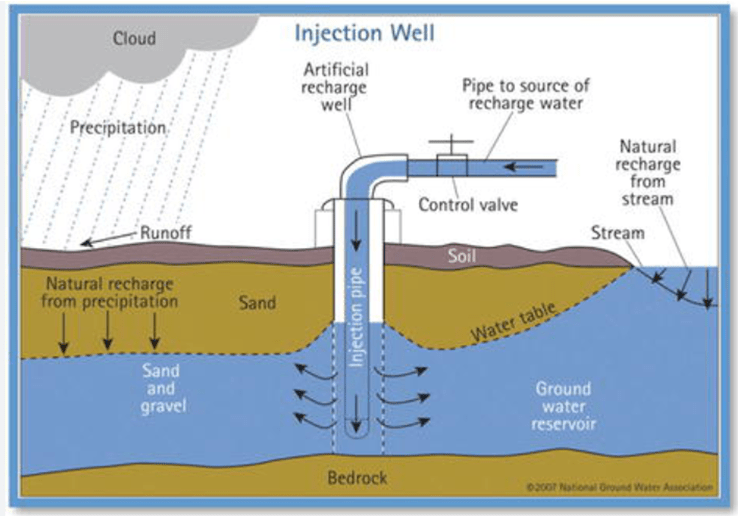
(For representation purpose only. Source: Intechopen)
If we can make such type of injection wells/recharge wells at numerous locations in the city, then it can recharge the aquifers at a faster rate and help control the problem of water logging and water scarcity in summers at the same time. Some cities have experimented with the recharge wells, but it is not confirmed whether they have achieved major success with that. I hope that the researchers, scientists and civil engineers would come out with some solution to this grave problem.
We would be happy to see more ponds and lakes in the open areas, and not on the roads and the public infrastructure sites!
 Anupam- The Dreamer
Leave a comment