While taking an afternoon stroll, I noticed a budhi amma selling jaamun in a small tokri at street-side in the scorching heat of summers. She was looking very frail and aged, still she was working hard under a hot burning sun to make the ends meet. I asked her “Amma, jaamun kitne me diye?” She replied, “Beta, 40 Rs. ke 250 gram”. I asked her to give 250 gm and in return, gave a 100 Rs. note to her. When she slid her skinny fingers beneath the jute bag to fetch for the change, I told her “amma, aap rakh lijiye”. And she glanced at me with a beaming smile and asked “beta, chai pilade”. I responded “amma, chai yahan thodi door par mil rahi hai, wahan se le lena”.
This was not just a simple buy and sell exercise in a marketplace. That was a heartfelt conversation with someone from older generation, a generation which had the human touch in everything they did, even in simple things. And today again I noticed the same amma. But today, she was having an afternoon nap besides her tokri of jaamun, unmindful of the threat of theft in the busy street. Maybe, she was too tired and I kept thinking when we even have difficulty in stepping out in this heat, this amma is able to have a nap. I wonder the poor people have developed much more resilience than the better-off population. Nevertheless, the jaamun tasted sweeter the other day when I bought from her. This is the joy of little things like buying from a poor yet kind street-side vendor that we had even in our childhood.
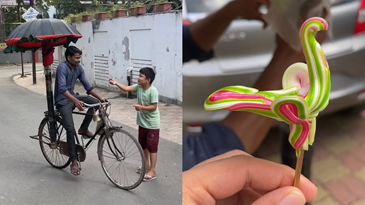
I vividly remember that when we were kids, there was a mahawat who came along with his elephant in our street. He used to charge Rs. 5 per head for the elephant ride down the street and back. And that used to make all of the kids so excited. Some kids used to ride the elephant and some just used to walk behind the elephant cheering for the kids sitting on it. The mahawat was kind enough to give some extra ride without charging any extra money. And how can I not remember the special “बम्बई की मिठाई”, wherein the seller used to pull off the candy off the bamboo stick from his hands and used to make different sorts of designs like wrist watch, butterfly, flower, bicycle, peacock etc. etc. The vendor obliged the children by making the design of their choice and even gave some extra bite as a bonus.
Then, the summers were a delight time as it was the ice-cream season. During the summer vacations, all the cousins assembled together in one home and waited keenly for the ice-cream wala. We recognized his bell which he used to ring in a specific manner and came out of our home to savour the ice-cream. The ice-cream wala sold “बर्फ का गोला” with all the artificially-made flavours which came in different colours- red, green, neembu, kala khatta etc. We had a specific bhaiya who came at specific time of the afternoon, at around 4 pm. He used to park his thela (cart) near our home because he was sure of selling atleast 10-20 gola. And he never refused to give some extra sharbat on the gola and even extra masala. He was poor but was kind-hearted, and he never refused to the children. But this is hard to imagine in a standardised setup of corporatized culture. You ask one extra spoon from the Baskin-Robbins or extra sauce from the Dominos guy, and they will frown upon you!
In today’s times, these small things of joy are missing. Now, many people live in high-rises in the cities. There are no elephant mahawats, ice-cream sellers which roam in the street, bambai ki mithai wala etc. The poor people and their livelihood have been captured by the corporatized market-economy. It is very difficult to find such people even in small cities, who at one point of time were found in vast numbers. These small vendors and small products made in very small cottage industries are very hard to find these days. Earlier, as a kid, we went to a roadside small shop and used to buy little toys, imli ki goli, small firki, lattoo etc. And whenever we had some pocket money of 2-3 rs., we used to purchase a lottery ticket which was worth 50 paise. If luck was on your side, you could make 2-5 rs. that day and buy a bigger candy. Now, the mobile technology had robbed us of all such games. Now, even a 7-year old kid plays “Call of duty” on mobile, but he will never know of the games that the elder generation used to play in their childhood.
The problem with standardization is that it robs a particular place of its speciality. Everything becomes common at every place. Small things which were peculiar in a place are now being replaced by common things, common food, common games etc. You can have the same pizza in the village as that in the city. There is literally no difference. Standardization and commercialization has its own share of positives as well as negatives. I hope that in our quest for positives in the era of hyper-technology and standardization, we don’t miss out on the small things of joy that we used to have earlier. And most importantly, we don’t lose the human touch that was a marked feature of majority of interactions that happened even in the marketplace. That I feel is a speciality of Indian culture, and we must not let it get robbed by the foreign-inspired materialistic culture.
 Anupam- The Dreamer
Leave a comment