Whenever there is an unfortunate and tragic event, a debate sparks off on the sidelines regarding the Karma-fal (कर्म-फल) theory. The proponents of this theory claim that every outcome is predetermined as per our own actions (Karma). It is onto us how to perform the Karma, but we cannot determine the outcome. And even of the outcome is an accidental or gruesome death, this theory is always working in the background. Some years ago, one gentleman asked me a question, “Japanese are very hardworking and honest people in general, then why God punishes them by tragedies like earthquakes and tsunamis?”. There are no easy answers, but the questions are many. Let’s delve a little deep into those and try to dissect the issue into finer details.
One of the foremost questions remains- “Is the outcome predetermined based upon our actions in this life or there is some connection with earlier lives?” Let us take an example. Suppose there is a person who has been all good throughout his life, never done any wrong deed, and has been kind to everyone he/she met. Yet, this person dies in a road accident abruptly in his/her youth. Was this the outcome (फल) of this life? Perhaps, not! Was it the outcome of his/her any previous lives (if you believe in theory of rebirth as is believed in Hinduism)? Maybe, yes! But, if someone argues that even if he/she did nothing wrong in previous lives also, we never know that he /she may be blessed abundantly in the next life due to this mishappening now, then the Karma theory falls flat as in this theory the outcome cannot precede the Karma. It is the Karma, which determines the outcome and not the vice-versa.
The second question that arises is this- “Is everyone really independent in performing the Karma?”. Many proponents argue that everyone is independent in performing one’s own actions and is not independent in getting the results borne out of it. But, there is a big problem. If everyone is independent in performing his/her own actions, then the outcome that is attributable to that person should not affect others. However, this is not true in reality! As you can see that a crime is committed by a criminal, but the outcome of that crime (e.g. theft, murder) is also borne by the person on whom the crime is committed even when he/she has absolutely no fault in that. Now, let’s make this more complex. Consider the following diagram, where each person is a node:
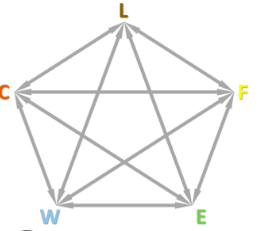
If we take each and every person in this world as a node, then there will be a complex web of outcomes of every person which in some way affects the other person. Does that mean that the other person has to bear the burden of the outcome of first person, even when they have no direct linkage? And if someone tries to solve this riddle by saying that the God has made such an arrangement, that even if a person (say Ronaldo) is affected by the outcome of other person (say Carlos), then also this can be attributable to the some earlier Karma of Ronaldo himself, then it becomes too heavy to understand that. Because in this case, can we really say that both Ronaldo and Carlos are truly independent in performing their own actions and that their actions always precede the outcome? I leave it upon you to decipher….
The third questions that pops up is this- “Has God made such an arrangement that all sinners have to come together to bear the brunt of a massive tragedy like Titanic, or a tsunami etc.?” By that logic, it would mean that majority of the people being born in Japan or disaster-prone areas are because of their ill-deeds in their previous lives. It is hard to imagine that sort of arrangement and birth of people in a particular place because of some earlier deeds.
The answers are not simple. Anyways, what else is in our hands than to perform our own Karma to the best of our ability? And moreover, whether or not there are answers to this, but I believe that this theory is more of a mindset. I remember an old story which was taught to us in 6th class- the story of “Old Tirumala”.
There was an old and wise man called Tirumala in the kingdom of a South Indian king. He had the habit of saying the pet phrase (तकिया कलाम) that “Everything happens for our own good”. Once the king while entering his courtroom accidently stuck his finger in a protruding nail on the door and bled profusely through the cut. The Old Tirumala started repeating his pet phrase “Everything happens for our own good”. The king got furious and ordered Tirumala to be imprisoned in the black cell. Then, after some days the king went for hunting in a dense jungle. He was stranded from the other persons of the hunting party accompanying him. Tired of hunting, he slept under the shade of a tree. Suddenly, the tiger appeared from the bushes and came near the king. The king was frightened to the core but couldn’t do anything, so he froze in fear. But, as the king was wounded and bleeding, the tiger smelled him but did not touch him. The king thanked the God for sparing his life and came to his court. He asked the ministers “Why did the tiger not eat me?”. Then someone answered, “My king! As you had a cut on your finger, so the tiger didn’t attack you as the tiger never touches an injured man”. The king was shocked and realized his fault. He immediately ordered to release Old Tirumala and asked for forgiveness, as indeed the cut on his finger was for the own good of the king. Had he not endured the cut, he would not have been alive today.
Whatever is the story, but one thing is clear- that doing the best under the present circumstances (Karma) is in your control, the outcome is not in your control. So, why not have the mindset of Old Tirumala that “Everything happens for our own good”. But mind it, this is not a defeatist mindset, rather a mindset where you worry about the things that you can control and leave the rest that you cannot control to the God or Karma theory or whatever you believe.
Till next time…..
 Anupam- The Dreamer
Leave a comment