Wait! What did you just read? Maharana Pratap- the great!!!! Was he really “the great”? But, you must have heard about “Alexander- the great”, “Ashoka- the great”, “Akbar-the great”! Historians have their own parameters to judge a person’s greatness or smallness like the extent of territory of a king/ruler, the number of wars he won, the richness of the empire etc. etc. Also, at times, the historians tell about the greatness of a king, on the basis of money/power/gifts/rewards they receive from the king himself or the person who makes them write history! For example, many kings patronized “राजकवि” in their kingdoms, who wrote extensive ballads/poems about the greatness of their king. And why will he not? Because afterall, the amount of gold asharfi/gold coins/land that he got from the king was directly proportional to the profligacy and flattery of the words of praise that he showered upon the king. And many-a-times, these राजकवि doubled as historians also because a lot of things about the earlier times can be understood by the limited literature that they wrote, among certain other archaeological things. So, as you can see, there is a clear conflict of interest here! The more money you give to a historian, the more great you become!
There are some historians, who write on the basis of facts. But, even then, the political or religious inclination and biasness can always creep in one’s writing. And understandably so! Afterall, a person is a product of his/her circumstances! Whatever you like, you will write about. And whatever you don’t like, you will not write about or write less about. The legendary Maharana Pratap was a victim of this tragedy! To make it clear, I am not here to demean the “greatness” of the other greats, but to set the record straight, we must acknowledge and appreciate the greatness of the other kings as well, who continue to inspire generations with their immense contribution to the mankind and the values that they represented. This reminds me of the lines of great poet Shri Shivmangal Singh ‘Suman’:
लघुता न अब मेरी छुओ
तुम हो महान बने रहो
अपने हृदय की वेदना मैं व्यर्थ त्यागूँगा नहीं ।
वरदान माँगूँगा नहीं ।।
The greats don’t need others to tell why they are great! Because their works speak for themselves. Maharana Pratap was one of such great men that walked on the face of this earth. His greatness is derived from the values that he stood for throughout his life. He was a sovereign ruler of the state of Mewar. When almost all the Rajput rulers of that era accepted (or were forced to accept fearing death) the suzerainty of the Mughals, there was one beacon of hope still left in the land of Mewar who denied giving up his sovereignty and independence of his people. It was a difficult decision to make when all your friends have sided with the more powerful ruler and are turning against you at the behest of the “great” ruler. But, he stood for his own self-respect and for the self-respect of the people of his land, at whatever cost that it may have entailed!
At the legendary battle of Haldighati in 1576, the Mughal army led by a fellow Rajput ruler, Man Singh, clashed with the much smaller army of the Maharana Pratap. Heavily outnumbered, the Mewar army fought valiantly. It is said that “War was like a sport to the Rajputs”! And rightly so. They fought wars for their honour, which was much more valuable than their lives. Rana Pratap was chopping the enemy like potatoes with his sword and piercing their intestines with his more than 80-kg “bhala”. But, when he made an attempt to kill Man Singh while riding atop the great Chetak and pounced on the enemy, the sword in the trunk of the elephant on which Man Singh was seated cut one leg of Chetak (see image below). When Jhala Singh sensed the danger to Rana Pratap’s life, he pleaded Pratap to give his royal insignia and armour to him to mislead the Mughal forces and implored him to leave the battlefield, because if the king will be no more, then how will they recoup and avenge the death of fellow brethren later. That was the supreme sacrifice of Jhala Singh, who was martyred on the battlefield.
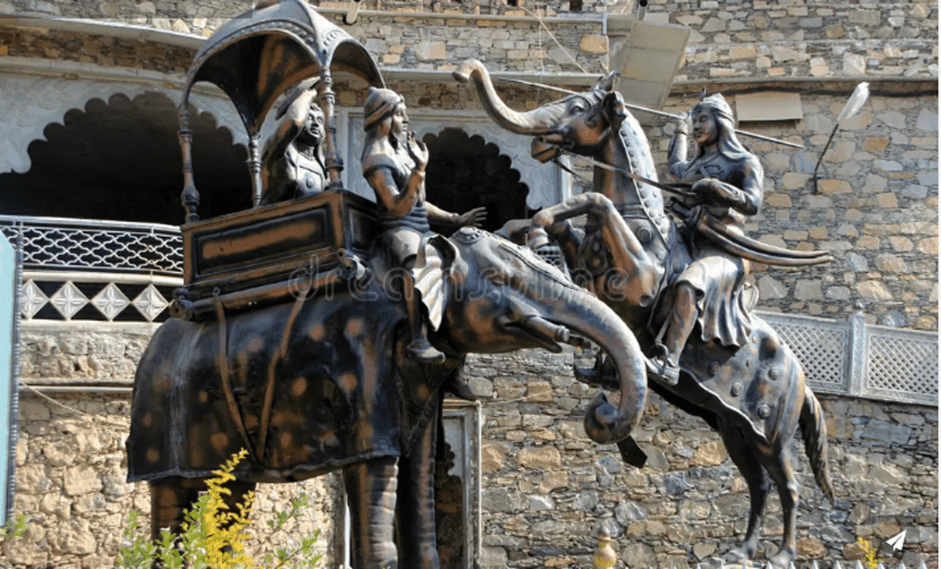
Rana Pratap atop Chetak pouncing on Man Singh with his bhala (displayed at Haldighati museum)
Rana Pratap was taken to safety by his loyal horse Chetak. The greatness of Chetak comes from the fact that despite being wounded heavily, he displayed utmost loyalty and devotion to his master and took him out of the battlefield. On the way out, there was a stream about 26-28 feet wide. Rana Pratap was thinking about how to cross the stream, but even as he thought, Chetak jumped with wounded legs and took his master to safety, and died soon after crossing the stream.
“आगे नदिया पड़ी अपार, घोड़ा कैसे उतरे पार। राणा ने सोचा इस पार, तब तक चेतक था उस पार।”
Now, you may say that how can the one who ran away from the battlefield be great? Maybe, that is one parameter. But, now consider this. The “great” Akbar never came to fight the war himself, is that a sign also of greatness or is that a sign of fear? If Pratap was martyred, then who would have led Mewar forces at the critical juncture was the quintessential question! Now, can you say who won the war? Akbar, maybe- because he was able to take control of some part of land. And maybe not, because he could not meet his objective of killing or capturing his enemy. Pratap always remained out of bounds of Akbar and fought guerrilla warfare with his army later in life. He chose to eat “घास की रोटी” while living in forests, but never accepted the suzerainty of Mughals.
Now, Pratap is great because he epitomized the values of self-respect, the love for his motherland, courage, sacrifice and honour of his people. He could have easily accepted the way followed by his fellow Rajput rulers to accept Mughal rule, but he didn’t. It would have been a much easier life to live under Mughal rule, and enjoy the benefits of being a king still! But, he chose to live in forests under difficult circumstances and give a tough fight to the Mughals with whatever scarce resources he had at his disposal. He had the support of his people, like Bhama Shah who gave away all their wealth to him, to give resistance to Mughals. He fought for honour and remained a symbol of independence and freedom, and also inspired many of the freedom fighters and continues to inspire millions even today.
Greatness is a virtue that only a few possess, and ever fewer can demonstrate through their thoughts, words and deeds. That’s why Maharana Pratap is “the great”! And even if he didn’t have historians on his side to sing the songs of his greatness, it doesn’t really matter, because the greatness of the greats cannot remain hidden for long….
Till next time….
 Anupam- The Dreamer
Leave a comment