We live in the self-proclaimed age of modernism. And we (here ‘we’ denotes humanity collectively) believe ourselves to be the most modern and most advanced of any of the human generations that have ever existed on this planet. After all, we all have studied “Darwin theory of evolution” in our schools, and therefore we believe that whatever traits and qualities are the best, have survived with us and the redundant/obsolete among them have become extinct.
But, there is an inherent flaw in this argument. Although, we can claim to be the best in terms of use of technology like internet, mobile, Artificial Intelligence, aeroplanes, bullet trains etc etc, yet I don’t think we are the best in terms of the values of humanity and the best of the knowledge systems that we had in the past. We also are not best in terms of health of a human being, a fact evident from the rising heart attacks in the young generation and several other occupational diseases, and are visibly frail than the generations that came before us. Although, at the same time, it is also a fact that the modern medical science is one of the best in terms of treatment of very complex diseases, with the help of advanced medical research and technology.
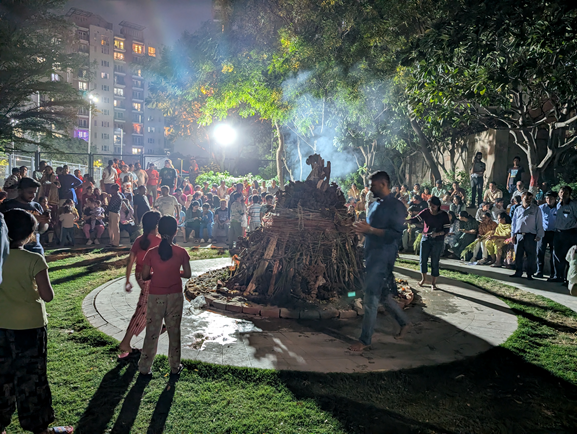
The topics that can branch out from the above synopsis are galore, however I would like to trace out the broad contours of the traditional vs. modernity debate. Today is Holika Dahan festival, and I went to witness the burning of Holika in the vicinity. It had been a long time since I witnessed this festivity from so close, so I was curious to know more about the traditions and the significance of this festival from close quarters. The preparations were just amazing, with the Holika made of the mango woods, chandan wood, cow dung cakes, the sacred thread tied around the woods, camphor, and various other sacred things. While waiting patiently for the fire to be lit, I was reading about the significance of this festival on the internet, when I came to know that this is celebrated in the month of “Phagun” on Poornima (full moon) night. It was then I looked into the sky to realize that indeed it was a full-moon night today.

The full-moon in the background, you can see
I was keen to know what the people around were doing before the holy fire was lit. An elderly man was having a serious discussion with his fellow elders, that no sacred work like “Holika dahan” should be performed when भद्रा काल is in force. Then, I read on internet that the भद्रा काल started at 10:36 a.m. in the morning today on 13th March and it lasts till 11:27 pm at night. Therefore, the elderly man was very sad and agitated that the organizers have decided to light the fire at 9:30 pm, even before the भद्रा काल ended. His friends advised him to approach the organizers to postpone the event, but he retorted saying that “tyagi ji ko bola tha, kuch nahi hua, ab to sablog aa gaye hain ab kuch nahi ho sakta”. And I was wondering that if there is a tradition of shubh muhurat since eterenity, then why not respect it this time around as well. But, I was just an observer, so I moved on to notice that the ladies, gents and a few children started performing pooja around the fireplace, each one with their unique traditions. Some gentlemen carried the wheat stacks in their hands, and some had different offerings to be made once the fire is lit. Then, I went on to read the significance of these offerings and was trying to appreciate the same, in the times when such things are becoming rarer and rarer. Most of the times, we have forgotten the actual significance and the reasoning behind our various traditions, and therefore have adopted them mostly in its form without its core substance.
After a while, it was time to lit the fire. And I was overjoyed to see that the honour to lit the fire was bestowed upon the elderly Sikh man, who looked very happy as he circumambulated the area with his small steps. What a beautiful example of a tolerant society and the best of the Indian traditions that a person from one religion was given the honour of performing the sacred ritual of another religion. This is our cherished heritage and the best of the values that we have preserved from older times.

The Sikh man, the guest of honour
As soon as the fire was lit, the people started to make offerings to the fire and started to go round in circles. Everyone was looking happy and charged up, even braving the hot flames that kept the struggle to stay close alive. One elderly lady specially caught my attention. Even when the people started moving away from the fire, the elderly lady stood closer than them to the fire and started her pooja. She had a beautiful thali adorned with water kalash, a diya, flowers, gulaal etc. And she continued her pooja with utmost devotion and reverence, unmindful of what people will say. It was like it was no one between her and her God at that moment. She was braving the flames and its heat, all while standing at the same place, even when the people were having the difficulty to keep close while doing circumambulations. It was a powerful image of a pious lady, who kept her traditions and her faith alive.
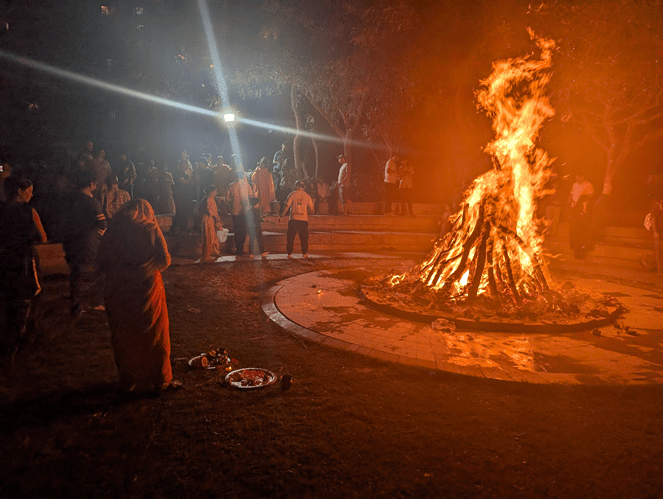

The powerful grandmother performing her sacred rituals
And it reminded me of the beautiful traditions carried on by our forefathers for eternity, particularly when we see them being performed by our grandmothers etc. till date. Our grandparents generation may not be as “modern” and as “tech-savvy” as us, but they were in many ways far superior than us in terms of human values and the wisdom gathered from ages. We cannot be “modern” if we lose hold of those values, wisdom and the best of our traditions. Tradition doesn’t mean that it is by itself obsolete, rather it is only when we cease to know the reasoning behind it and stop to question on the basis of rationale and logic, that they seem to have outlived their utility, which is not true most of the times. It goes without saying that nothing should be accepted on the face value without critical thinking.
To me, there is no conflict between the traditions and modernism. They are complementary to each other and even reinforce each other. Infact, we are at the cusp of human development, where we can enjoy the best of the traditions and the best of the modernity. Traditions without modernity, face the risk of going down into the oblivion. And modernity without traditional values and knowledge, is like a building without a foundation. After coming home, I read about the story of Bhakt Prahlad to refresh it in my mind, which we have read in our childhood or seen in “Shri Krishna” serial on the TV long long back. It gives a crucial insight of the good values that we can inherit and take inspiration from. It also keeps us close to our roots and foundation, and may help us to continue Indian civilization as the longest surviving ancient human civilisation in the times to come still. We can’t forget our heroes from our traditions/folklore/beliefs. We need to read about Bhakt Prahlad as much as we need to read about the modern day superheroes like Spiderman. Is it really that hard to do it in the age of modernism?
It just takes one generation to break the transmission of good things from our past to the future. We cannot risk to be that cursed generation. Period!


 Anupam- The Dreamer
Leave a reply to Pawan Kumar Singh Cancel reply