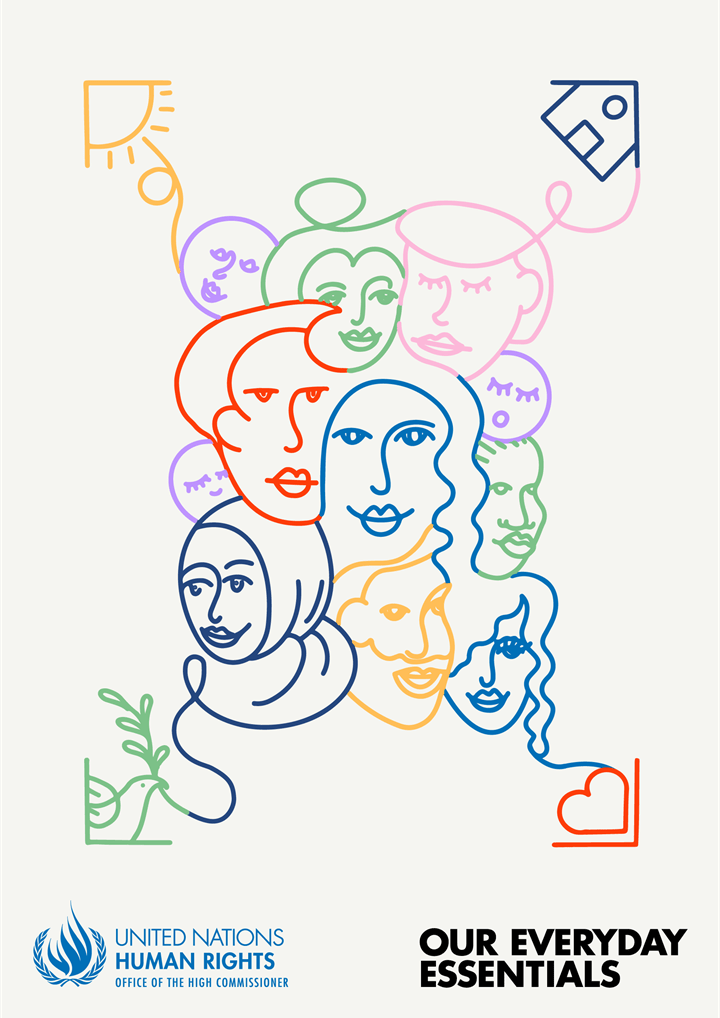
Source: United Nations website
Yesterday, on 10th December, it was the International Human Rights Day. The theme chosen by the United Nations this year was- “Human Rights, Our Everyday Essentials”. There was a beautiful conference organized by the National Human Rights Commission (NHRC) at Bharat Mandapam to commemorate the occasion.
The Chief Guest, the Hon’ble President of India, Smt. Draupadi Murmu, in her address shared her beautiful thought that when we think about human rights, we must think about the person standing on the last paaydaan (last step), it is another matter whether we are able to reach him/her or not. And this is not just the role of the government, rather it is the collective responsibility of the government, institutions like NHRC, SHRC, civil society, civil servants, media etc. She spoke her heart out when the emotions in her voice advocated earnestly for the benefit of the “Antyodaya”, the last person or the most underprivileged person in the society. She implored everyone to think over the fact that there are many people in the society who have “ears but cannot hear, mouth but cannot speak, eyes but cannot see, so can we become the ears, mouth and eyes of such mook-badhir people?”
It is rightly said that “A chain is only as strong as its weakest link”. Similarly, the society is also only as strong as the strength of its last person. If the last person is weak, then the society as a whole cannot be strong because the weak person will become a liability for the society and even can indulge in anti-social activities that can destroy the social fabric of the society. So, this is essentially a bottom-up approach of development, where you focus on the last person standing in the last row, instead of the traditional top-down economic growth model. In the top-down approach, you focus on the economic development by focusing on the uppermost bracket of the society, where it is believed that the rich people will spend more and employ poor people and slowly the wealth will trickle down to the last person. But, this model is not flawless because first, the trickled-down fruits of development are very dismal for the last person, and second it takes a hell lot of time for this trickling to take place. In contrast, in the bottom-up model of development, you directly target the last person and make interventions to provide basic essential human rights of food, education, healthcare, water, sanitation, home, electricity etc. These are not some “luxurious rights”, so as to say, rather they are “everyday essentials”, which is the main focus of this year’s UN Human Rights Day. Only when these rights are provided directly to the people at the last rung of the ladder, can we strengthen the weakest link of our human chain!
Similar pattern of thought, I noticed in the priorities of Dr. APJ Abdul Kalam after he demitted the office of the President of India. I had the good fortune of attending his public meeting in person in the town of Rangia near Guwahati, where he addressed a large gathering of thousands of poor little students from the government schools of Assam in a large open field. He wanted to inspire very young and impressionable students to work hard in life and study, to become good citizens of the society. If you happen to see many videos of Dr. Kalam, mostly he is seen interacting with little students, often from primary classes. Rarely you would see his videos of addressing senior students and college students. His focus was on the poor little students who come from the underprivileged backgrounds because he knew the biggest change will come from these students! Students from good backgrounds, may not need his guidance and encouragement as much as the students from humble backgrounds, so he made sure that he interacted with such little kids. By doing this, he was also focusing on the Antyodaya i.e. the poor primary class students from the backward communities in the backward regions of the country. So, when you empower people from the last rung of the society, the development level of the society rises drastically in a short period of time.
Coming back to the conference, the President also emphasized that the rights come along with the duties. Because if we don’t perform our duties of becoming a good citizen, then the rights will also lose meaning. So, it has to be ensured that while exercising our rights, we are also conscious of our duties, because only then we would not infringe upon the rights of the other people in the society. If my right to freedom of speech is not exercised with restraint on the choice of words, then soon the language may turn foul and can affect other citizens’ right to dignified life.
Having said that, the human rights are the basic essential inalienable rights that should be available to all irrespective of the nationality, age, gender, economic status, race etc. So, the ideals of equality, liberty, dignity and justice, must be the moral compass of the society in the times to come to guide the humanity as a whole towards the path of higher development. It may sound to be a utopian goal and we may never achieve it in full for each and every person, however having a great goal can atleast take us one step closer towards that utopian dream. If we are able to take even a few steps toward the glorious goal of human rights, then it would still be a big achievement for the humanity as a whole.
Till next time….

 Anupam- The Dreamer
Leave a reply to wastelandmortally7f359e8743 Cancel reply