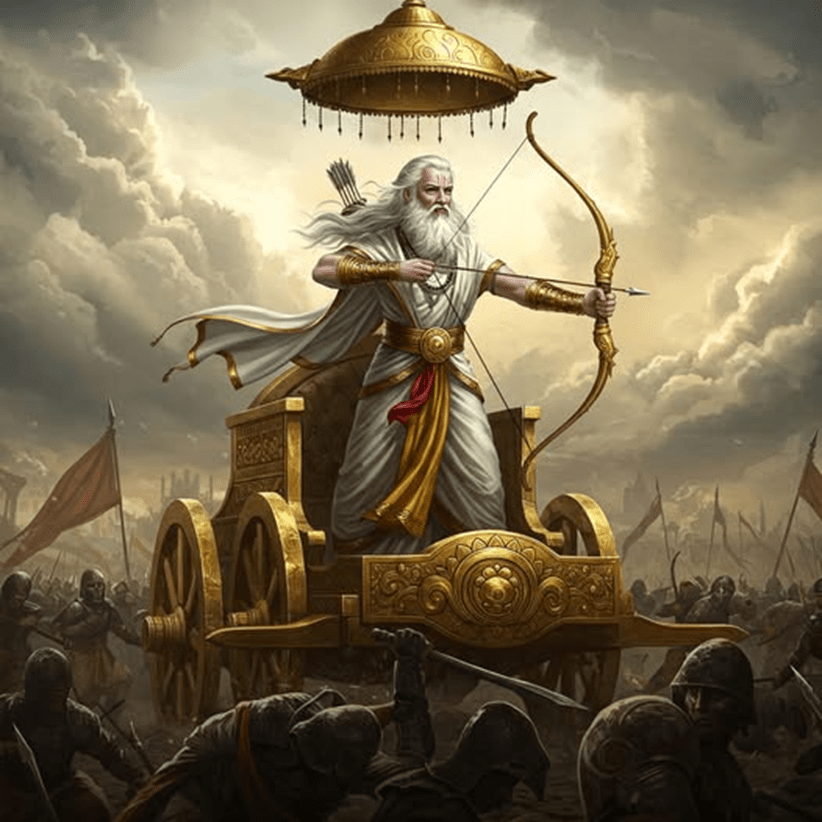
I have had the fortune of learning from some of the great teachers. One among them was Prof. Satya Chaitanya, who was a faculty at the famous XLRI, Jamshedpur. We had 1 week of Management Development Programme (MDP) during our training at TATA Steel, which was hosted by XLRI. And there we met many legendary teachers, one of them being Prof. Satya Chaitanya. I was particularly amazed by his immense Sanskrit knowledge and his innovative approach in relating the ancient wisdom of our great epics i.e. Ramayana and Mahabharata to the modern day management.
During one of the lectures on “People management”, Prof. Chaitanya enumerated one of the qualities of a great leader i.e. Don’t let your morals stand in your way of doing good! And what better example could there be other than the legendary Bhishma Pitamah a.k.a Devvrata a.k.a Gangaputra Bhishma. Study of every character of Mahabharata could run into volumes, but his story is particularly peculiar in the sense that his was an epic case of moral dilemma- of choosing between good and bad. Let’s pick a few threads of his story one by one.
First, Bhishma took a vow in good faith to remain celibate all his life. It was out of utmost devotion to his father, who fell in love with Satyawati. To cut the story short, the turn of events led him to take a solemn vow for which he came to earn the sobriquet of “Bhishma”. So far so good. But, the problem starts when Bhishma let his vow stand in his way of doing good. When the sons of Satyawati died without a heir to the throne and Satyawati and her father (whose selfish wish of seeing Satyawati’s son as the king led Devvrata to take the solemn vow to not father a child) asked him to renege his vow, Devvrata let his resolve come and stand in his duty to sit on the throne and then provide a heir to the throne later. For him, the means were more important than the end, the procedure more important than the end goal.
Then, when the Pandavas lost everything- including their empire, themselves and their wife in the game of dices to Kauravas, then also Bhishma chose to remain silent. He knew that what was happening over the game of dices wasn’t good, but he again let his promise to his father come in his way of doing good. He had earlier promised to his father when he was alive that he would always see the shadow of his father in the incumbent king and abide by the king’s orders. He didn’t imagine that a foolish man can also come to occupy the throne and then he would have no other way than to follow the foolish king. And even if we discount his imagination, then what stopped him from giving wise counsel to the foolish king and stop him from doing immoral things? He again let his ideals and morals come into his way of doing good.
Then, in later stages of Mahabharata, when he had to choose the sides- between moral and immoral, he again chose Kauravas as their father, Dhritarashtra, was sitting on the throne. He vividly and convincingly knew that the Kauravas were on the wrong side of law, and the prosperity of the kingdom lay in the hands of Pandavas, then also he chose to abide by his vow to his father. Bhishma Pitamah always chose means over the ends, even after suffering endlessly under the burden of his own guilt and even to the peril of going down the immoral pathway. He cried at times and cursed himself of not being able to do good for the kingdom, but then also he told only one thing again and again upon being implored by the wise Vidur “पुत्र , मैं विवश हूँ”. Even when Draupadi was being disrobed, he sat in the corner of the raj darbar watching the unfortunate turn of events with agony, apathy and helplessness. He knew throughout that what was being done was wrong, but he chose to do nothing just to protect his vow.
Now, contrast the case with Shri Krishna. Krishna always gave more importance to the ends than the means. For him, the end goal was always good, benign and in the interest of humanity. The means could be turned and twisted to suit the end goal. For example, during the epic war, he used Ghatotkach against Karna as a fail-safe strategy to extinguish his one-time power when he knew that Karna has reserved that power to kill Arjuna. For him, the death of Ghatotkach was a sacrifice and a cost to be paid for winning the war.
Then, when he came to know that Ashwathama’s father Dronacharya would come to the ever truthful Yudhishthir to confirm the death of his son, he knew that Yudhishthir would die but would not tell a lie when indeed Ashwathama was alive. So, he played another trick and told Yudhishthir that one elephant named Ashwathama had died. So, he forewarned Yudhishthir that he can safely tell the truth to Dronacharya by saying that “अश्वत्थामा हतो नरो वा कुंजरो वा” (Ashwathama died- but I don’t know whether it was a man or an elephant). So, when Dronacharya heard the rumour of his son’s death he came straight to Yudhishthir for confirmation. And as Yudhishthir uttered the first two words अश्वत्थामा हतो, Shri Krishna blew his conch (shankh) loudly. Poor Dronacharya couldn’t hear नरो वा कुंजरो वा and he laid down his arms on hearing the news of his son’s death and was killed on the battlefield.
You may argue which way- Bhishma’s or Krishna’s was better. No particular approach can be perfect in every scenario, but what is the use of any approach when the end goal is not good. If the means and ends are both good, nothing better than that! But, if the means are twisted and turned at times to achieve the good ends, then can’t it be called an acceptable approach if done with bonafide intentions? Can that be applied to modern day management, in private sector and in government? There are no easy answers and that makes the life more interesting….
Till next time…..

 Anupam- The Dreamer
Leave a comment