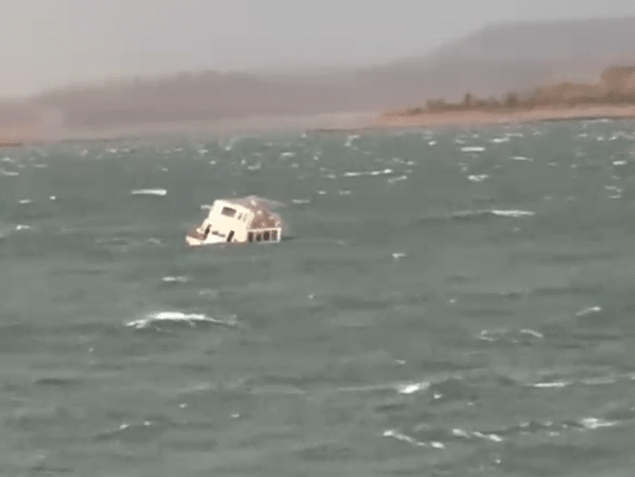
The recent tragic cruise capsizing incident in Bargi dam, Jabalpur, again raises some very pertinent questions about the safety culture in our society. We cannot control the vagaries of the nature like storms, cyclones etc., but certainly we can be better prepared to face such incidents in case they happen. In this particular incident, from the visuals just before the incident, it is clear that the tourists were not wearing the safety jackets! Who is to blame for that? The tourists? But they will ask the question- is it really needed? The cruise management? But, it will say that- the jackets are kept for precaution, but they aren’t “really” needed as no bad incident ever happens. The administration? But they either don’t care much, or if they care then the law enforcement is inadequate due to reasons like apathy, corruption, or incompetence. Or the society as a whole is to blame? Because we all believe in living “भगवान भरोसे ” (as per God’s grace)!
Infact, a few days ago I was a part of the group of people riding a cruise boat on Dal lake in Srinagar without any safety jacket on. The jackets would have obviously been kept in the closet, but who cared? Atleast, the weather was pleasant, but so was it in Bargi dam just before the incident happened! What if suddenly our cruise had capsized due to any reason- like a leakage or some accident with another cruise boat? How many of us knew swimming and could rescue ourselves? There are no easy answers, because all’s well till it’s actually well, but if it’s not, then we find it easier to put on a helpless fatalistic mask on our face!
When we think a little deeper into this, it is actually the culture of a society that determines how an average citizen conducts himself/herself with other people. In our society, there is a lack of safety culture due to many reasons.
Firstly, safety is often not the “first thing” that we build into the systems (administrative/technical/engineering etc.). Like, while determining the ability of the cruise boat to navigate in the stormy weather conditions, do we check all the safety aspects of it like carrying capacity, emergency controls, weather forecasting and navigation, pilot’s competence? I am afraid if everything is done as per the Standard Operating Procedures (SOP). For us, safety is just a check box to be ticked sluggishly to satisfy the authorities that be!
Secondly, safety puts an extra cost on everything and being a very cost-sensitive society (where ironically the cost of human lives is not much) we tend to disregard safety inbuilt into the systems just to save a few million rupees!
Thirdly, we the people, love freedom! Isn’t it? I will prove it to you- we don’t want to wear helmets on bikes, we don’t want to put seatbelts even in airplanes if not forced and are quick to throw it away as soon as the plane touches down on the tarmac, we don’t consider to buy safe appliances in our homes and instead go for fancy/cheaper versions.
Fourthly, many people in our society have fatalistic attitude “जो होना है वो होके रहेगा, उसको कोई नहीं रोक सकता” (whatever has to happen will happen, nobody can stop that), so why to unnecessarily bother about it? Infact, we love to boo others who in case insist on following the safety instructions! We don’t even consider that many of the times, things are controllable and the tragic accidents could be minimized with a little extra care and precaution.
Fifthly, it is the attitude of the administration and political class, who consider themselves as apathetic, immune and unaffected by the loss of lives of common people. Only when some “high-profile” accident happens, there is a proper enquiry, otherwise everything is merely an eyewash!
Contrast this with the Japanese society, where they “safety culture” is ingrained in every aspect of life. The students are taught to save themselves in the event of earthquake, tsunami, cyclones etc. The society is taught to follow traffic rules, to minimize loss of avoidable lives on the roads. The adherence to highest standards of quality, fool-proof systems, safety culture, punctuality in timing, kaizen, Total Quality Management (TQM) etc., is just remarkable! The examples are many but the point here that their society is much more resilient to handle disasters- natural and man-made.
And if we don’t take lessons from such societies and adopt into our systems, then we cannot blame the nature for the follies committed by us! If we really value every human life, then probably we will! But, as long as there is no value to the life of common person, we will have nothing to say but to cut sorry figure every time such a tragedy takes place. Period!


Leave a Reply