If you have gone on any trek in the mountains or hills, you can easily tell what is the most important thing that will help you complete the trek with ease- no Nobel prizes for guessing this, it is the SHOES without a shred of doubt! You can do without enough food or chocolates, or without enough winterware, or other peripherals, but one thing that you cannot do without is your SHOES! And that’s where I faced the toughest challenge on this trek trip of mine- trek to hampta pass (at height of about 14,100 feet above sea level) which connects rugged Kullu valley to snow-clad Lahaul-Spiti valley in Himachal Pradesh.
I used to be very proud of my Quechua shoes which I bought long long ago, on my first trek with Tatas. I used to pronounce it केचुआ until the start of this trek, when I met an employee of Decathlon who told me it is actually केशुआ! Nevertheless, I used those shoes as sports shoes, to ride bikes and on other trips also. So, when it came to this trip, never did a thought cross my mind that I should consider buying a new pair as it has gotten very old. But, as fate had it, I happily took these shoes alongwith one pair of slippers.
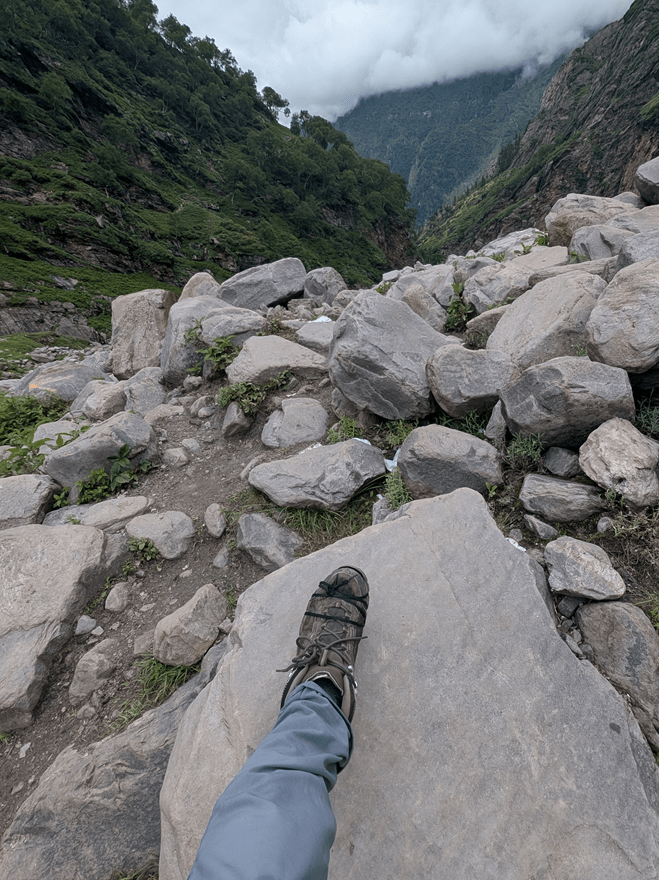
We arrived at the starting point at Jagatsukh in Manali. There also, there were hundreds of shoes for rent. But, I was confident (or rather sure) of my shoes that I didn’t even ask the rental price for the boots and additional spikes for walking on snow. First day went well when we trekked from the Jobra village till Chikka base camp (at height of about 10,500 feet above sea level). Then, on the second day the soul (sole) went out from the body of my left shoe, not figuratively but literally too. The sole went off from the toe and middle portion and soon I was searching for something to tie the sole to the shoe body- something like rope, wire, anything and everything. The guide didn’t have anything so he asked me to continue till we get something to hold on to. Soon, God listened to my prayers and just after crossing the ice-cold chilly river with bare legs I found a lawaris (stray) shoe left by some other trekker ages ago. I felt a splurge of joy and my excitement knew no bounds and I immediately took out its black lace and tied it around the sole and the shoe body. See this picture:
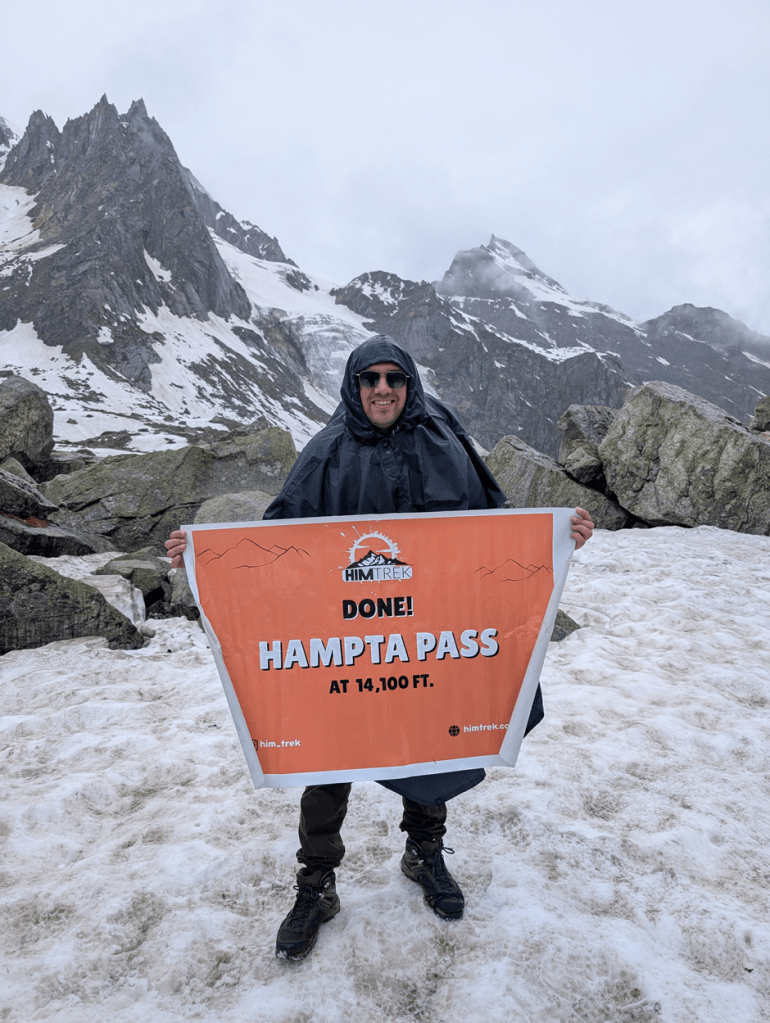
So far so good. Somehow, walking through the snow and ice and crossing the slippery boulders, I reached the top of Hampta pass (located at a height of about 14,100 feet above sea level) while managing with the damaged left shoe. The lace came out again and again, and at one point of time, when my hands went numb due to freezing cold, I had to take help of Harinder bhaiya, our guide, to tie the sole back to the shoe. You can see that the shoe lace is still on the toe of my left shoe here at the top of pass:
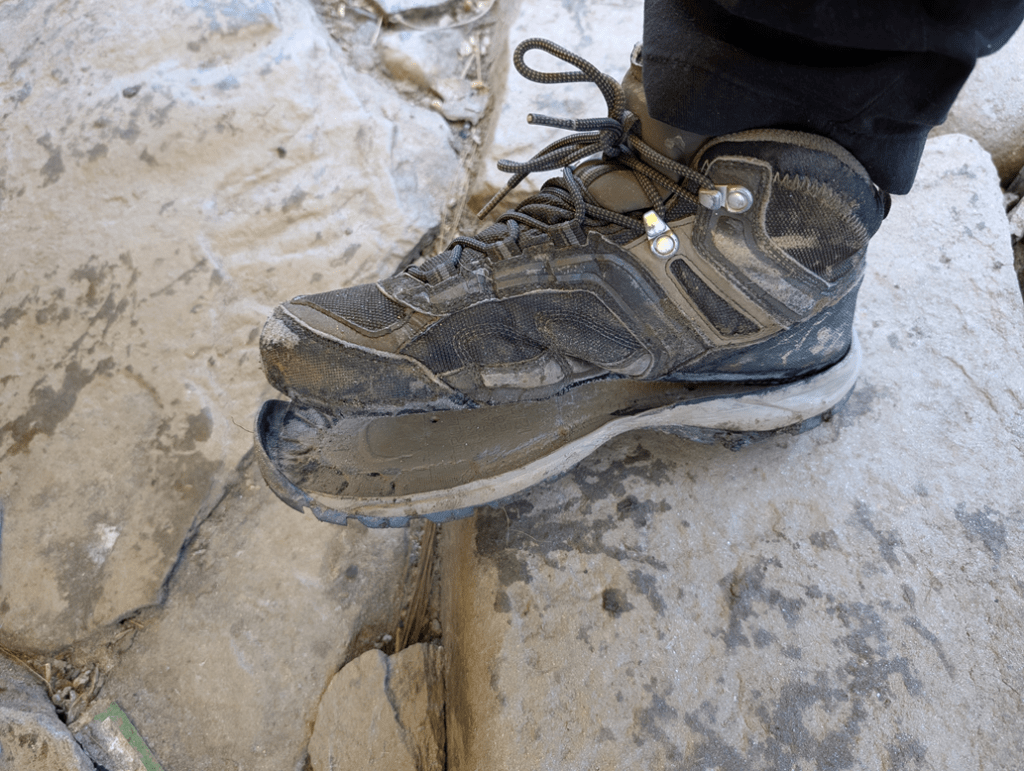
When I thought that my biggest trouble of the trek has been temporarily solved and I kept praying to God that please let me finish my ardous trek though hills, stone, snow and mud-laden route, the sole of my right shoe also gave up while descending down from the height of 14,100 ft to about 12,600 ft (Shea Goru base camp)! And I thought to myself- why God, why today only, why could it not last for 2 more days? See the condition of the right shoe below on the third day during descent:
But, then there was no point lamenting what has been already done! I knew that I would have to find another rope or if I am lucky then again a shoe-lace. But, this time I wasn’t that lucky to find a shoe-lace which is long and sturdy enough to hold sole together with the shoe body. So, I tried different combinations like “plastic ki rassi” from the tent-side waste. But, it broke again and again.
On the beginning of the fourth day, one of our team-mates who also suffered the same misery with his one-week old Quechua shoes (he was unlucky with a defect piece), got a big rope which he stole from a nearby tent. We both took a knife from our kitchen tent early in the morning at about 6 am, and started to unwind that thick rope. One rope unwound into 3 small thin ropes. So, he took a few pieces and I took other few. One rope I wound it around the shoe and rest I kept in the side-pocket of my trek pants for future exigencies, if any. Because now, the shoes could not be trusted any longer. After sometime, the sole of the right shoe completely came off. So, towards the end of the fourth day, I took out the spare thin rope and tied it across the back of my right shoe also.
So, effectively the left shoe had one bandage with the back part of the sole struggling to come out of the body (fortunately it didn’t!), and right shoe had three bandages (at the front, in the middle and at the back). On the fifth day, I was managing with my slippers in the camp site, and I told my guide that I will throw these shoes away in the river stream flowing by. But, when my guide reminded me that the rivers are sacred, I immediately realized my folly and apologized. Then, I decided that I will take the shoes back to home. And see miracles happen when you least expect them. The shoes did not betray me on the fifth day and I somehow managed to walk with them till I reached home. I would have walked about 30-40 km with these shoes on this trip alone. And now, my shoes look like this:
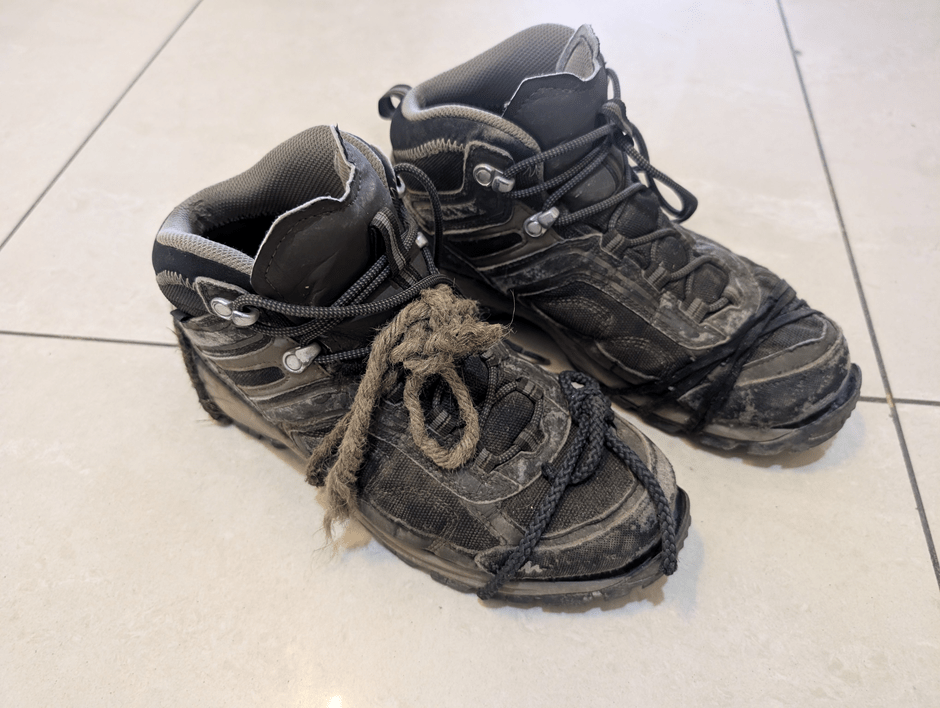
And I am so proud of them that they lasted for 13 long years! Long live Quechua! Long live the fighting spirit! This shoe story and the persistent struggles proves yet again- “Where there is a will, there is a way” 😀
 Anupam- The Dreamer
Leave a comment