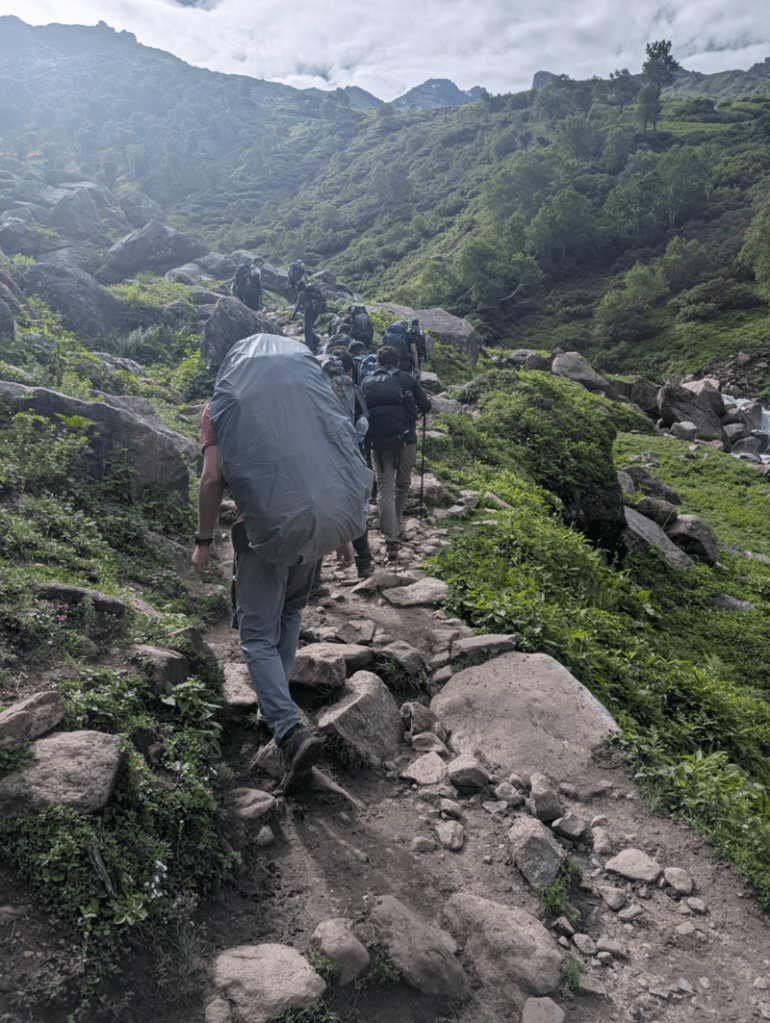
Sir Edmund Hillary, the first person to climb Mount Everest, the highest peak in the world, remarked that “It is not the mountain that we conquer, but ourselves”. Looking back at my trek experience at the Hampta pass (situated at a height of 14,100 ft above sea level), I cannot agree more with Mr. Hillary. On the face of it, it seems that the goal is only to conquer the mountain by climbing over it. But, in reality, the things that we get to learn in the process are even more important, including the conquest over our own fears, inhibitions and the ability to push ourselves beyond our comfort zones.
These are the key takeaways for me from my recent trip. Hopefully, you could also relate to some of them:
1. Pushing yourself out of the comfort zone
For the people living on the plains, mountain experience is tough, really tough. Going from plains to the mountains, it is not just physically tough but also mentally tough task. Physically, because you don’t a habit of walking on tough terrains against the gravity when gaining height. So, it is tough on the body, especially the leg muscles and the lungs. Also, the air becomes thinner at higher altitudes, and consequently breathing becomes tough and heart rate increases due to lower oxygen levels. Mentally, because pushing out of comfort zone makes you uneasy. We have a habit of staying in our comfort zone and anything which forces us out of that zone invites our ire. And there are times, when your body gives up and you feel intense pain, then you start questioning why I am pushing myself so hard. At this point, the mind comes into play, which is the sole reason you continue on your journey despite the hardships.
2. You get to know yourself more
During the journey and after its conclusion, you get to know that the limits that you had set on yourself were just temporary and meant to be broken. You get to know that the body is capable of enduring much more than you ever thought like walking in the ice-cold freezing waters, bearing with the minus temperatures, drinking mud and algae infested water at times, walking for long distances. On top of this, the slow and laid back life of mountains gives you more time to introspect, thereby you get to know yourself better. All of this contributes to pushing your limits further, and you become a stronger version of you, physically, mentally and emotionally.
3. You start appreciating little things in life
When faced with adversity and scarcity, you start to cherish the basic things which you took for granted. Things as simple as brushing your teeth, going to shit, cooking food, washing utensils, etc. which seem to be so simple in the comfort of your homes, suddenly seem to be as hard as hell in the mountain trek. It forces you back into the early-man era, where one had to walk down to the streams to brush, drink water, getting water for cooking and washing utensils. Going to shit in the open mountains in a tent also seems to be so cumbersome a task that several of the teammates don’t even poo for some days straight! And thankfully the trek is for a few days only, imagine if you would have to spend a few months like this, then 99% of us will definitely go bonkers!
4. Minimalism is the right way
In usual life, we tend to be so resource-savvy that we don’t realize the difference between resource-usage and resource-wastage! Because we have plenty of water, food, clothes, accessories, gadgets at our disposal, we don’t value them adequately. But, mountains teaches us that minimalism is the right way to sustain ourselves for long. When you know that clean water availability is low, food is scarce and difficult to make, firewood or cylinder are not easily available, there is no electricity, then you try to conserve these resources. Wastage tendency drops automatically and you learn to survive on the minimal resources. And, then comes the realization that if you could survive on the minimal resources in the mountains, then why can’t the same be replicated in the plains? You already know the answer!
You also tend to be more resourceful in mountains, as you already know that the resources are less and you have to achieve more with less. Even you try to preserve waste or use waste in innovative ways to your advantage. For example, I found a thrown-away shoe whose lace I took out to tie my own broken shoe sole. Otherwise, who cares about a thrown away shoe in the plains?
4. You connect to the nature more
When you in the nature, away from the artificial gadgets and tech-savvy life, you appreciate how beautiful is the nature. Suddenly, the sunrise, sunset, the streams, the trees and wildlife seem to be so refreshing. Some people even see some wild fauna and flora for the first time in their lives. Some see the fields and the crops for the first time, and try to make sense whether this is wheat crop or this is bajra? Some are mesmerized by the morning chirping of the birds and the night-time rattling sounds made by the numerous insects and creatures. We have almost forget what the night-skies look like until we are away from the light pollution and get an opportunity to look with awe to the stars and the planets above us. If you are lucky, then you can get a glimpse of the Akashganga galaxy, and suddenly you realize how small you are in the larger scheme of things. At that point, you realize that you are nothing more than a speck of dust and all your ego which you had built carefully, comes crashing like a pack of cards. This also reminds us to ponder over things like from where we have come and to where we will go after the death.
5. Environmental consciousness increases
When we see the pristine environment and come to appreciate the nature in its true beautiful form, then we realize the harmful impact that our greed has made on the Mother Nature. We have destroyed natural rivers and lakes in the cities, we have exploited resources like anything, we have obliterated trees from urban landscapes, we don’t have spaces for wild animals and birds etc. Basically, we have stopped enjoying the environmental goods and services, that we were offered free of cost by the nature. Things which are considered luxury in the cities like good air quality, good water quality, good food quality, are available for free in the mountain villages. No need to spend unnecessarily on the air purifier, or RO or organic foods! However, in the cities, the air is polluted, water is polluted, soil is polluted, food is polluted with chemicals. I wonder is there any natural thing left around us which is not polluted?
Atleast, when we see things in their natural state in the mountains, our consciousness increases about the harmful impact that our tech-savvy and resource-heavy lifestyle has had on the mother nature. And maybe, we could use that consciousness to do something good to restore the balance of nature back to its near original state.
6. You start to appreciate life more
When you see the hardships in the mountain life, where there are virtually no schools, hospitals, restaurants and shopping malls, cars and bikes, then you automatically become grateful for the things you have in life. Maybe, you don’t have luxurious branded things, but compared to the mountain people, whatever you have is much more to sustain life comfortably. You thank God that your life has been easy that way. And when you witness the daily risks to your life in the mountains by the torrential rains, Glacial lake outburst flow, landslides, road accidents, you start valuing your life more. Otherwise, without risks to your life, everything seems normal and easy.
7. Leadership and teamwork qualities
When faced with adversity in life, you automatically have to step up your leadership skills in order to survive. First, you have to lead yourself before you can lead others. You have to show courage, determination, persistence, clarity of goal, teamwork to be successful on your mission. You have to carry your own burden before you can help others in their mission to be successful. And without teamwork, the big missions and goals can never be achieved. Therefore, you have to have emotional intelligence and good communication skills to bring clarity of purpose and pull your team together.
8. You have to find your own path
Just like the rivers flowing in the mountains, which find their own path by meandering through big boulders, cutting across the terrain, and finding the path of least resistance to flow, one has to find own path while ascending or descending down the mountains. There is no “one perfect way” to achieve your aim, you have to find that on your own. You can obviously take guidance from those who climbed earlier than you, but still their path or ways may not suit you. Everyone is unique and everyone is special, so you have got to be your own light! And everybody has to carry his/her own weight uphill or downhill. The weight of the rucksack you carry could vary, but still you have to carry your own body weight on the trek. Noone can do it for you.
9. Mountains are unforgiving and harsh
Mountains are very beautiful, but at the same time they are also very harsh and unforgiving to those who don’t respect the mountains. If you don’t respect the lifestyle in the mountains by acclimatizing, and don’t take adequate safety measures while trekking, don’t listen to your guides, then the mountains punish you by giving you injuries, taking a toll on your physical and mental health, breaking your resolve, giving you Acute Mountain Sickness (AMS) like nausea, vomiting, headache and diarrhea. And if you don’t take care of the freezing temperatures, you can get cold, shivering, numbness in your limbs, and frost bite in extreme circumstances. Mountains can also take your life in the harsher environments, if you aren’t careful. But, for those who respect the mountains and take adequate precautions, the mountains reward them with the beautiful views and memories which become a part of you for long after coming back from the trip.
Till next trek…. 😀


Leave a Reply