Before starting the discussion, here are some facts about the size of the universe to blow away your mind:
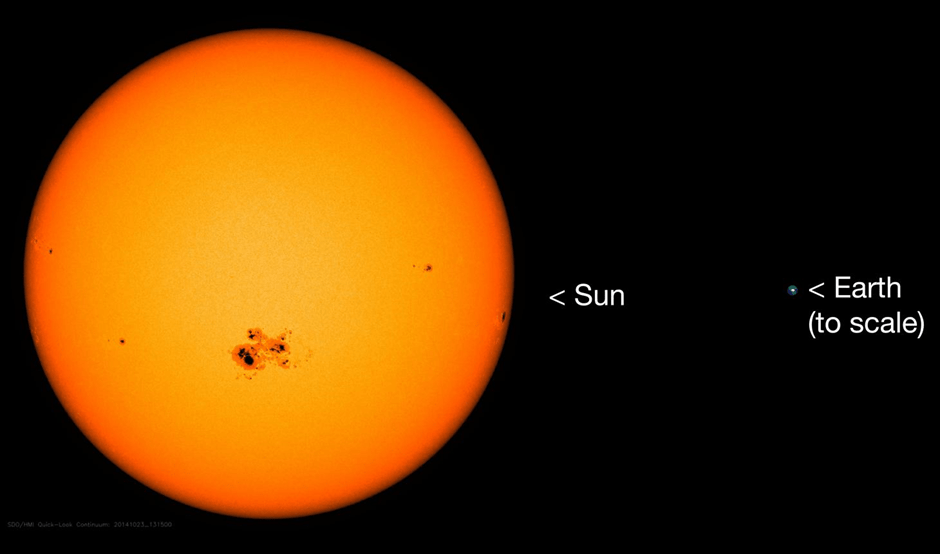
1. Earth is very tiny Compared to the Sun
You could fit about 1.3 million Earths inside the Sun.
2. Our Solar System Is Much Bigger Than You Think
If the Sun were the size of a football, Earth would be a tiny grain of sand about 25 meters (82 feet) away.
3. Our Galaxy Is Enormous
The Milky Way:
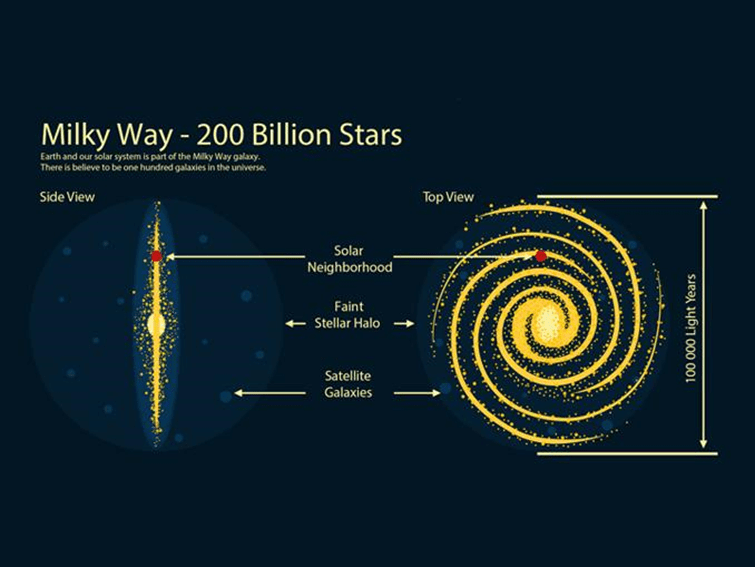
- Contains 100–400 billion stars. If you travelled at the speed of light, it would still take 100,000 years to cross it.
- And is approximately 100,000 light-years across.
For the perspective, 1 light year (distance travelled by the light in one year time at a speed of about 3,00,000 Km/s) is approx. 9.461 trillion kilometres.
The great-circle distance between Delhi and New York is approximately 11,750 km. That means: 1 light-year is roughly equal to 805 million one-way trips between Delhi and New York.
Another way to imagine it- If you flew from Delhi to New York every single day: It would take about 2.2 million years to complete 805 million one-way trips.
That’s just one light-year—and the nearest star beyond our Sun is about 4.37 light-years away!
4. Voyager 1 Has Been Traveling Since 1977
The Voyager 1 spacecraft has traveled for nearly 50 years. Yet it has only just entered interstellar space and remains far closer to the Sun than to the nearest star.
5. There Are Hundreds of Billions of Galaxies
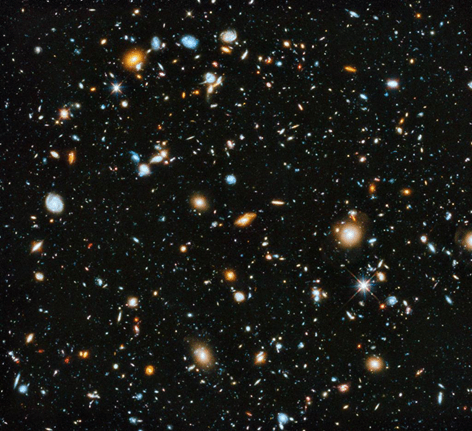
Astronomers estimate the observable universe contains hundreds of billions of galaxies. Many galaxies themselves contain hundreds of billions of stars. That means the observable universe likely contains around 1022 to 1024 stars—more stars than all the grains of sand on Earth’s beaches.
6. We Can See Only Part of the Universe
The observable universe has a radius of about 46.5 billion light-years. You might expect it to be only 13.8 billion light-years (the age of the universe), but because space itself has expanded while light was traveling, the most distant observable regions are now much farther away.
7. The Universe Is Probably Much Larger
The observable universe is simply the part whose light has reached us.
The entire universe could be:
- Hundreds of times larger,
- Trillions of times larger,
- Or even infinite.
At present, scientists do not know.
8. You’re Made of Ancient Stardust
The carbon in your body, the oxygen you breathe, the calcium in your bones, and the iron in your blood were forged inside stars billions of years ago before being scattered through space by stellar explosions.
In a very real sense, every person is made from recycled star material.
9. If the Universe Were One Calendar Year
Compress the 13.8-billion-year history of the universe into one year:
- January 1: The universe begins.
- September: Our Solar System forms.
- December 31, around 11:52 PM: Dinosaurs appear.
- About 11:59:46 PM: Modern humans appear.
- The last fraction of a second before midnight: Recorded human history.
10. Looking Far Away Means Looking Back in Time
Every telescope is a time machine. When the James Webb Space Telescope observes a galaxy 13 billion light-years away, it sees that galaxy as it was 13 billion years ago, not as it is today.
11. The Observable Universe Is Incomprehensibly Large
The observable universe contains roughly:
- 2 trillion galaxies (current estimates).
- Around 1022 stars.
Even these enormous numbers describe only the observable portion of the cosmos.
Now, imagine the extent of infiniteness of the universe and where we stand in there. There are 2 trillion galaxies, and each galaxy having hundreds of billions of stars, which means about 1022 to 1024 stars—more stars than all the grains of sand on Earth’s beaches! And in that sand, we are situated inside the solar system of just one grain of sand i.e. our Sun.
At first, it is mind-boggling and very unsettling at the same instance! We think of solar system as infinite, and yet solar system is nothing in comparison to the whole universe! And humanity has not yet been able to travel to the nearest star i.e. Sun.
If we sit down and really think about the extent of the universe, then within this INFINITY, a realization will slowly start growing on us that we are indeed NOTHING! Not even a speck of dust! What is the value of one grain of sand in the whole of Earth? That is exactly the value that our beloved Earth holds in the universe!
To some, this may be humbling. To some, this may be perplexing. To some, this may be beyond imagination. To some, it may sound crazy. To some, it may make them feel a part of infinity. And to some, it may feel that they are a zero/know/cypher or just nothing.
You may start to feel that you are of the age of universe and hence immortal, and you may feel that you are just a blip on the time-screen of this universe and hence a mere mortal. At this moment, all that you imagine of yourself goes for a toss and your lofty egos blow away like a speck of dust in a duststorm.
And there you are- a mere mortal human being who sees only a fraction of a second in the time-scale of universe, but with a consciousness to realize the duality of infinity and nothingness!
Now, that you realize the extent of the universe, what do you do with that infinity? And what do you do with that nothingness and nullity?
Infinity (∞) and nullity (0) at the same time?
I will leave you at that to think for yourself…..


Leave a Reply