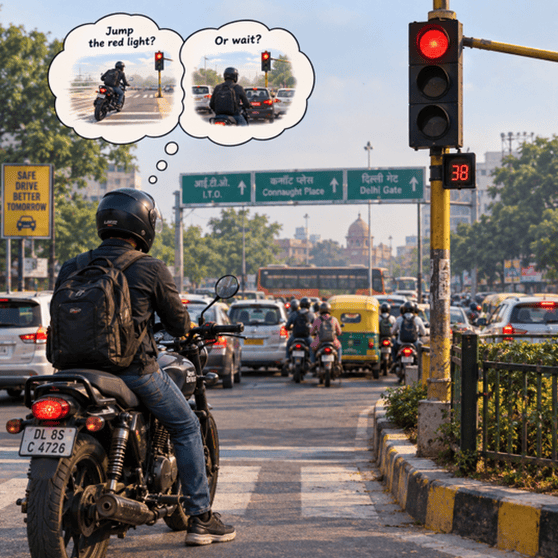
If you stand at any general traffic signal in any typical city of India (apart from the major big traffic signals), you can observe following different of behaviours with respect to compliance of traffic laws and rules:
- First, is the category of people, who only follow traffic rules when there is traffic police to monitor violations (or to issue challans)- effectively when it is convenient for them, whenever they forsee that there is no traffic police/CCTV, then they conveniently jump the red light
- Second, is the category of people, who follow traffic rules only because it is an obligation imposed upon them by the state– there is a constant battle inside their head whether to jump the red signal or not – but they fear reprimand by the state, so mostly they follow
- Third, is the category of people, who abide by the traffic rules and never jump the red light even at night time when the roads are almost deserted- because they consider it as part of their duty towards the state and fellow citizens
- Fourth, is the category of people, who don’t care about the laws or rules- they see any law/rule as a restriction on their freedom, so they don’t care to follow
Now, let’s do behavioural analysis behind these different behaviours. Human being, by nature, loves freedom! Freedom to move, roam around, eat anything he/she likes, do/not do any work etc etc. This was true in the aboriginal societies when the population was very very less. As population grew and civilizations developed, we had to live in a society where there had to be certain rules/laws to regulate the behavior of humans. Because, without any law, there would be anarchy in the society and all the people will fight with each other as the right of one will impinge on the right of another. This happens because the resources are limited in society, so one’s right to desire something, say food, limits others’ rights to have the same thing!
The core issue underlying the typical behaviours listed above is in the “DIFFERING UNDERSTANDING OF THE NEED OF THE LAW/RULES”, which is the cause of the behavior (effect).
The fourth category doesn’t believe in the concept of society and civilization. They think that laws are not needed at all. They believe that they are law unto themselves or they are above the law. I don’t need to mention which kind of people fall in this category.
The first category also doesn’t believe in the concept of society and civilization. They too think that laws are just there to make their life inconvenient and they would be better off without them. Just that they fear the punishment by the state, so they follow the law. But, as soon as they see that the state is not enforcing punishment or is a weak state, they conveniently violate law. At this moment, they jump to the fourth category. For example, if a citizen knows that state is not checking traffic violation or tax evasion, then he/she conveniently goes on violating signal/ evading tax.
The second category understands the need of the laws to some extent. They know that lawless society can create chaos, so they mostly follow the laws, however unwillingly! But they prefer to live in a state where there are minimal laws or rules. For example, many NRIs shifting their bases to low/zero tax jurisdictions because they don’t want to pay taxes.
The third category fully understands the need of the laws/rules. They understand that without them, there would be a complete anarchy in the society. They don’t see laws as constraining their rights and freedoms, instead they see them as enabling their freedoms. For example, if they follow traffic rules, then life of every citizen including themselves would be safer on the roads. Also, if they pay their due share of taxes, then the government will get revenue, which would again be spent on the welfare activities for the citizens and security of the state.
The moot point, here is how much percent of each category is there in the society right now?
I think 1st– 40%; 2nd– 20%, 3rd– 10%, 4th– 30%
Till next time….


Leave a Reply