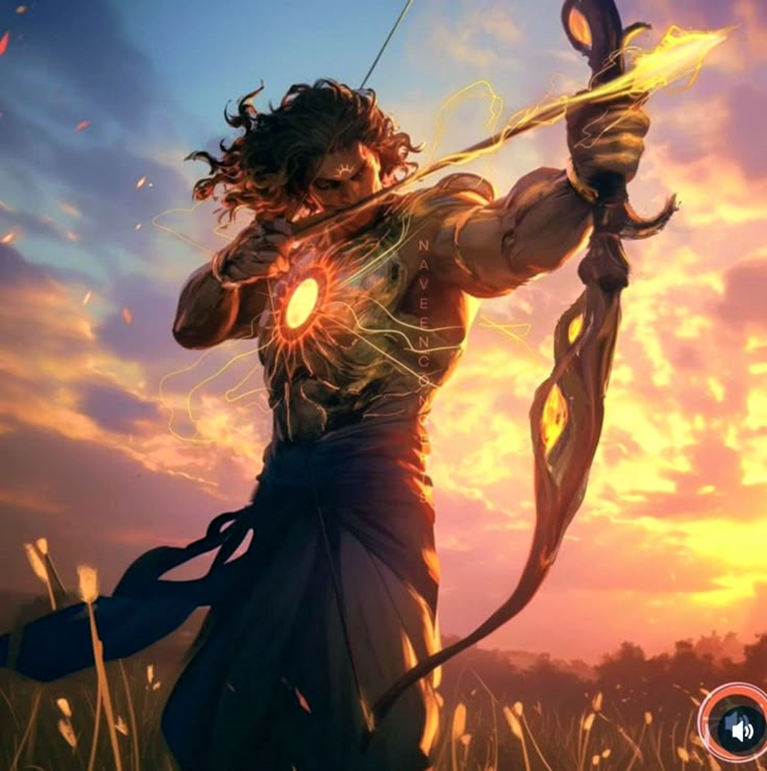
Before delving deep into the story of the legendary warrior Karna, I would strongly recommend you to read the fantastic book called “रश्मिरथी” (Rashmirathi) written by the great poet Shri Ramdhari Singh Dinkar. This book tells the story of Mahabharat from the perspective of Karna and the title means “the one who rides over the rays of sun” i.e. Karna (son of Sun God).
After reading the book and even otherwise, if you know something about Karna, then you would feel that destiny had done great injustice to him since birth. First, he did not inherit the name of his father (Sun God), and his mother disowned him at birth as she was a maiden when he was born. Despite being born with great talent and Kundala-Kavach (कुण्डल-कवच) protecting him, he was called a soot-putra (सूत पुत्र), son of a charioteer. Then, he had to tell a lie before his guru Parshurama that he was a Brahmin to get shiksha, who later curses him to forget his shiksha when he will need it the most, upon discovering that he was actually a kshtriya! Then, he was not allowed to take part in duel with Pandavas as he was a “low-born”, where only warriors born in upper castes were allowed to showcase their talent. At this point of time, Duryodhana did the right thing by saying that the warriors don’t have a caste and made him the king of Anga Pradesh, so that he can fight, but eventually stopped by the gurus to fight. So, you might feel that all his life Karna didn’t get the respect and honour that was “due” upon him, as he was the eldest Pandava and ideally he should have been the heir to the throne of Hastinapur! Infact, he suffered injustice at many junctures in his life.
You can sympathize with Karna and feel that he should have got justice! But, circumstances prevented that on many occasions. That is perfectly fine and nothing wrong to demand justice! But, having said that, even if you are at receiving end of justice, then also injustice done to you should not be answered with injustice! The reason is simple- when you yourself do injustice onto others, then you lose the moral right to demand justice for yourself! Period.
For example, when Karna knows that his friend Duryodhana is on the wrong side of the “nyaya”, he supports him with his full strength! On one side, you may say that he was being loyal to his true friend who gave him honour and in turn he had pledged his life to Duryodhana. But on the other side, Karna cannot be absolved of the wrong that he did while being with the crooked Duryodhana, even when he knew that Duryodhana was wrong! Injustice cannot be given upper hand above the values of loyalty and friendship. Infact, he could have given wise counsel to his friend and asked him to mend his ways. But he didn’t! Then, Karna didn’t intervene when Draupadi was being disrobed in the full court, because he put his friendship over the honour of a woman! Infact he also made some lewd comments on Draupadi! Again, when the Mahabharat could have been averted if Duryodhana gave fair share of land to the Pandavas, he didn’t intervene to counsel his friend Duryodhana. He was also a party to kill Abhimanyu by deceit in the chakravyuh! So, there are many instances when you see that Karna tried to do injustice or was a party to injustice perpetrated by his friend Duryodhana!
But, had Karna chosen the path of justice to answer injustice rendered upon him, then he would have become a greater legend. Legend, he was, no doubt, in terms of courage, strength, his charitable nature, but still that was overshadowed by his support to injustice. And he had to suffer the fate that he had. As it is said that –“An eye for an eye will make the whole world blind”, so one injustice can never be justified with another! There is no moral sanctity to injustice, so no matter how great you are, if you are on the side of injustice, then you will have to face the consequences! Period.
Now, you might think that why did I tell you this story as such conditions are not present in today’s world! But, wait! The conditions may not exactly be the same, but you can always learn from the past good things/mistakes that others have committed, so that you don’t repeat them in the present. The ethical and moral premise doesn’t change across the different eras, even if the situations may be a little different. Mahabharat is not just an epic or a folk story, rather it is a legendary treatise on ethics and morality, and the more we delve into it, the more we can learn from it….
Till next time….


Leave a Reply